
How Open Banking Accelerates Instant Payments Adoption
Instant payments are no longer “nice to have.” They’re quickly becoming the expected way to move money for payroll, bill pay, marketplace payouts, insurance claims, rent, B2B invoices, and last-mile disbursements.
What’s still slowing adoption isn’t consumer interest—it’s friction: onboarding, account verification, fraud risk, reconciliation, and inconsistent user experiences across financial apps.
That’s where open banking changes the game. By enabling permissioned access to bank data and account capabilities through secure APIs, open banking reduces the cost and complexity of building instant-payment use cases.
It turns slow, manual, and risky steps—like verifying accounts, confirming balances, or proving identity—into real-time, automated workflows. When those workflows become reliable, instant payments move from pilot programs into everyday operations.
In this guide, you’ll learn how open banking speeds instant payments adoption across common use cases, what infrastructure pieces matter most, how compliance and fraud controls are evolving, and where the market is headed next.
What “Open Banking” Means in Real-World Instant Payments
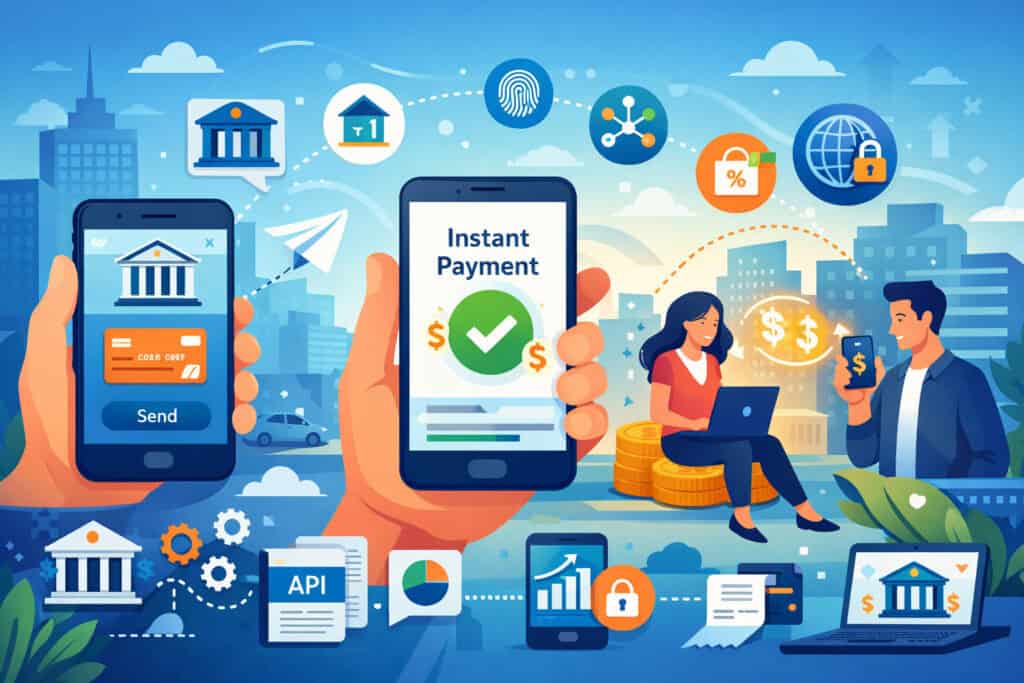
Open banking is best understood as a set of permissioned data-sharing and action-enabling rails that let a consumer or business authorize a third party (like a fintech app, merchant platform, or payment provider) to securely access financial account information—or initiate certain actions—without sharing passwords.
Instead of relying on brittle screen scraping or manual document uploads, open banking uses standardized APIs, strong authentication, and clear consent to exchange data and signals in near real time.
For instant payments adoption, open banking matters because it closes the gap between “money movement” and “money certainty.” Instant payments can settle in seconds, but the surrounding workflow often doesn’t.
Businesses still need to know: Is this the right account? Is it active? Does it belong to the right person? Will this payment be disputed? Can we reconcile it automatically? Open banking answers those questions faster by providing verified account attributes, transaction context, and ongoing status updates—so organizations can confidently push funds instantly.
Another practical point: open banking supports portable financial identity. When customers switch banks or open new accounts, instant-payment setups often break.
With open banking permissions, users can re-link accounts quickly, update their payout preferences in minutes, and keep recurring flows running. That continuity reduces churn and boosts repeat usage—two critical drivers of instant payments adoption.
Open banking also improves user experience. Instead of asking customers to find routing numbers, upload voided checks, or wait days for micro-deposits, apps can confirm ownership and readiness through consented account access. The result is faster onboarding, fewer drop-offs, and a clear path to scale.
Why Instant Payments Adoption Often Stalls Without Open Banking

Instant payments technology can be available, yet adoption can lag due to operational constraints. The biggest blockers tend to be verification friction, fraud concerns, uncertain funds availability, and back-office complexity. Open banking directly targets these pain points.
Verification friction is a silent conversion killer
Many instant payment programs fail before a single payment is sent because users abandon setup. Manual entry of account details leads to errors. Micro-deposit verification adds delay and confusion.
Paper-based or document-based verification creates extra steps and support tickets. Open banking replaces these with a consent-based account link flow, reducing the time to “ready to pay” from days to minutes.
Fraud and dispute exposure increases when speed increases
When money moves instantly, the window for intervention shrinks. That makes fraud teams nervous—especially for first-time payouts, high-value disbursements, and account-change events.
Open banking helps by providing stronger signals: account ownership, historical behavior patterns, account tenure, and transaction context (all within the scope the user authorizes). Better signals mean fewer false positives and fewer blocked legitimate users, which is essential for instant payments adoption.
Liquidity and risk teams need certainty, not just speed
Instant payments settlement doesn’t automatically solve whether the payer has enough funds, whether a payout destination is correct, or whether a sender is authorized.
Open banking can supply balance data (where available and consented), recurring income signals, and account status indicators. That allows platforms to create smarter risk rules—approving more transactions instantly while reserving manual review for edge cases.
Reconciliation and exception handling become the hidden cost center
Instant payments can create a flood of transactions, and if reconciliation isn’t automated, finance teams get overwhelmed. Open banking supports better transaction labeling, richer metadata exchange, and faster matching of payments to invoices, claims, or payouts.
As reconciliation gets easier, organizations feel safer scaling instant payments adoption beyond limited pilots.
The Infrastructure Shift: From Batch Money Movement to Always-On Payments

Instant payments adoption isn’t just about “faster ACH.” It’s a structural shift from scheduled, batch-based operations to always-on payment experiences. Open banking provides the connective tissue that helps businesses operate in that always-on world.
In modern instant payment systems, the rails can move money 24/7/365, but the business workflows around them must also become 24/7/365. That includes customer support, fraud monitoring, limit management, funding controls, and exception handling.
Open banking helps automate the decisioning layer so fewer cases require human involvement outside business hours.
In the current domestic landscape, multiple instant payment rails exist, and adoption is growing fast. For example, The Clearing House reported that its RTP® network reached 343 million transactions and $246 billion in value in 2024, showing strong year-over-year growth and increasing real-world usage.
This matters because volume growth increases the need for standardized onboarding, secure account linking, and reliable fraud controls—exactly where open banking reduces friction.
Meanwhile, the Federal Reserve launched the FedNow® Service to support instant payments nationwide and expand access for institutions of various sizes.
As more institutions connect, more apps and merchant platforms will want to send and receive instant payments—but they will still need open banking-style permissioning and standardized access to account data to make those payments safe and user-friendly at scale.
This infrastructure shift also changes product expectations. Users increasingly compare every money movement experience to the best experience they’ve had elsewhere: instant confirmation, clear status, minimal steps, and immediate availability. Open banking makes it easier to deliver those expectations consistently.
How Open Banking Enables “Instant” Across the Full Payment Lifecycle

Instant payments adoption accelerates most when “instant” applies to more than just settlement. Open banking helps compress time across the entire lifecycle: onboarding → verification → authorization → sending → confirmation → reconciliation.
Instant onboarding and account linking
Open banking reduces account setup from multi-day processes to a short consent flow. Instead of collecting banking credentials, manual account numbers, and verification documents, applications can guide users through secure authentication and permission grants.
This shrinks the time to first payment and dramatically boosts activation rates—especially for gig platforms, marketplaces, and B2B portals.
Real-time account and ownership verification
Many payout errors and fraud cases come from misdirected accounts or account takeover. Open banking can confirm that an account is real, active, and belongs to the user who is requesting the payout (subject to the data made available and the scope of consent).
When these checks are automated, businesses feel safer offering instant payments by default rather than as an exception.
Smarter authorization and risk scoring
Open banking adds context: patterns of inflows/outflows, account age, and user behavior signals. That context enables risk models that approve legitimate instant payments more often—while still stopping suspicious activity.
Crucially, it also helps avoid over-restrictive controls that would otherwise throttle instant payments adoption by creating “declines for good users.”
Real-time status and better customer support
Instant payments reduce “where is my money?” calls—if the UI shows clear status. Open banking can support that by keeping account links current and enabling quick re-verification when users switch banks or update their payout destinations. Fewer broken links means fewer failed payments and fewer support escalations.
Faster reconciliation and reporting
For businesses, reconciliation is the difference between a pilot and full adoption. Open banking can improve transaction attribution and enable automated matching to invoices, claims, or payroll records.
When the finance team isn’t drowning in exceptions, leadership becomes more willing to expand instant payments adoption across more payment types and customer segments.
Key Use Cases Where Open Banking Drives Instant Payments Adoption
Open banking accelerates instant payments adoption most strongly in use cases where speed directly affects customer satisfaction, operational cost, or competitive differentiation. Below are the categories seeing the most momentum.
Marketplace and gig-worker payouts
Platforms live and die by payout experience. Sellers, drivers, and freelancers want immediate access to earnings—especially during peak periods or emergencies.
Open banking improves this flow by enabling rapid account linking and reducing payout failures due to incorrect details. It also allows platforms to manage account-change risk more intelligently, which is one of the biggest fraud vectors in gig payouts.
In addition, open banking supports portability. Workers may switch bank accounts, open new accounts, or use multiple financial apps. When account updates become simple and secure, instant payments adoption rises because fewer users are stuck on slower payout methods due to verification delays.
Insurance claims and disaster relief disbursements
Insurance carriers and relief organizations often face trust challenges: recipients want to know funds are coming, and organizations need to prevent misdirection and fraud.
Open banking can speed claim payout verification and reduce the lag between approval and disbursement. Faster funds delivery improves satisfaction and reduces inbound calls, while stronger verification decreases fraud exposure.
Bill pay and rent collection
Bill pay has historically relied on cards or batch bank transfers. Instant payments offer immediate confirmation, which is valuable for rent, utilities, and last-minute bills.
Open banking helps by making it easier for customers to connect accounts and authorize recurring flows. It also supports smoother transitions when a payer changes banks, preventing missed payments that lead to fees and disputes.
B2B invoices and supplier payments
In B2B, “instant” is less about consumer convenience and more about working capital, cash forecasting, and supplier trust. Open banking enables cleaner onboarding for business payees, reduces payment exceptions, and improves reconciliation—especially when paired with invoice metadata and automated matching logic.
As these workflows mature, instant payments adoption expands from urgent exceptions to standard supplier payment options.
Payroll and earned wage access
Payroll is high-stakes and deadline-driven. Open banking helps validate payroll destinations and detect account changes that could indicate fraud. For earned wage access, the onboarding and verification speed is essential; users won’t wait days. Open banking makes it possible to verify eligibility and deliver funds quickly while keeping controls strong.
The Regulatory and Standards Momentum Shaping Open Banking and Instant Payments
Open banking growth is increasingly guided by formal rules, recognized standards bodies, and clearer expectations around consumer permission, privacy, and liability. This matters for instant payments adoption because regulation and standards reduce uncertainty for banks, fintechs, and merchants—making them more willing to invest.
A major development is the move to implement consumer personal financial data rights under Section 1033 of the Dodd-Frank Act through the Consumer Financial Protection Bureau (CFPB).
The CFPB has published rulemaking materials describing how covered providers would need to make certain consumer data available to consumers and authorized third parties, with privacy and security protections.
This creates a pathway toward more consistent, permissioned data access—reducing the patchwork of proprietary integrations that slow market-wide adoption.
Standards bodies are also becoming more formally recognized. The CFPB has recognized Financial Data Exchange (FDX) as a standard-setting body under its personal financial data rights framework.
When common standards gain legitimacy, integration becomes cheaper, safer, and more repeatable. That encourages more institutions and platforms to build open banking experiences and embed instant payments more deeply into their products.
The impact on instant payments adoption is practical: clearer standards reduce implementation risk, speed vendor selection, simplify audits, and improve interoperability. Instead of building bespoke “one-off” connections that don’t scale, organizations can adopt patterns that are more likely to remain compliant and compatible as the ecosystem evolves.
Security and Fraud: How Open Banking Makes Instant Payments Safer at Scale
Security concerns are the number one reason many organizations hesitate to expand instant payments adoption. Open banking helps address those concerns, but only if it’s implemented with strong controls. The goal isn’t just to “share data.” It’s to enable permissioned, auditable, and revocable access that strengthens risk decisioning.
Stronger authentication and reduced credential risk
Traditional credential-sharing creates systemic risk: stored passwords, compromised logins, and replay attacks. Open banking reduces credential exposure by using standardized authorization flows, limiting what third parties can access, and allowing permissions to be revoked. This reduces the attack surface that would otherwise grow as instant payments adoption increases.
Better account-change controls
Account-change events are a prime fraud moment. Criminals often attempt to reroute payouts by changing bank details. With open banking, platforms can require re-authentication, confirm ownership signals, and apply step-up verification before enabling instant payouts to a new destination. That makes instant payments adoption feasible for higher-risk payout categories.
Smarter transaction monitoring with richer context
Open banking can provide behavioral context (within the authorized scope) that improves fraud detection. For example, unusual account activity patterns, suspicious new links, or inconsistent identity signals can trigger holds or reviews—while legitimate users proceed instantly. This reduces both fraud losses and customer frustration, creating a healthier adoption flywheel.
Clearer audit trails and compliance evidence
As instant payments adoption grows, regulators and partners will expect strong auditability. Open banking permission logs, consent receipts, and standardized access records make it easier to demonstrate compliance and investigate incidents. That operational confidence is essential for scaling instant payments across more customer segments and payment sizes.
Merchant and Platform Strategy: Using Open Banking to Win With Instant Payments
Instant payments adoption is not only a technical rollout—it’s a go-to-market strategy. Businesses that combine open banking with instant payments can create product advantages that are hard to copy quickly.
Make instant the default, not the upsell
Many platforms treat instant payouts as a premium feature. That can work in the short term, but it can also limit adoption. Open banking reduces the cost of onboarding and verification, making it more feasible to offer instant payments broadly.
The strategic move is to reserve premium pricing for value-added services (like higher limits, enhanced reporting, or same-day support) rather than basic speed.
Reduce churn by improving payout reliability
Nothing drives churn like failed payouts. Open banking reduces errors in account details and helps keep links current. As payout reliability improves, user trust grows—and users opt into instant payments more readily. That’s a compounding effect: fewer failures → fewer support costs → more promotion of instant payouts → higher adoption.
Bundle instant payments with cash-flow tools
With open banking signals, platforms can offer smarter features around instant payments: dynamic limits, cash-flow dashboards, automated savings, and predictive funding. These features turn instant payments into a broader financial experience rather than a commodity transfer. That makes adoption stickier and increases lifetime value.
Build cross-platform portability
Users don’t want to re-enter bank details everywhere. Open banking supports a more portable linking experience, which reduces friction when users adopt new apps or services. The easier it is to connect and authorize, the faster instant payments adoption grows across the ecosystem.
Future Prediction: Where Open Banking and Instant Payments Are Headed Next
Over the next few years, several trends are likely to accelerate instant payments adoption further—especially as open banking becomes more standardized and trusted.
First, expect more consistent API access patterns and fewer legacy workarounds. As personal financial data rights frameworks mature and recognized standards bodies expand their influence, implementations should become less fragmented. That will reduce integration time for new products and increase competition around user experience rather than connectivity.
Second, instant payments adoption will increasingly be driven by business use cases, not just consumer convenience. B2B supplier payments, insurance disbursements, and embedded finance workflows have massive volume potential. As open banking improves verification and reconciliation, these categories become easier to scale safely.
Third, fraud controls will become more real-time and adaptive. Open banking data will feed decision engines that update limits, apply step-up authentication, and approve transactions with more precision. This will reduce losses while minimizing unnecessary friction—making instant payments feel both fast and safe.
Fourth, expect richer payment messaging and reconciliation automation. The “money movement” is already fast. The next frontier is ensuring every instant payment carries the metadata needed for straight-through accounting. Open banking will help by enabling better account context and smarter matching rules.
Finally, adoption will expand as more institutions and platforms connect to instant rails. Continued growth metrics, like the RTP network’s large year-over-year increases in value and volume, suggest that real-time usage is moving into the mainstream—and open banking will be a key enabler for the next wave of use-case expansion.
FAQs
Q.1: What is the difference between open banking and instant payments?
Answer: Open banking is primarily about permissioned access to financial account data and capabilities through secure interfaces. Instant payments are about real-time money movement—sending and receiving funds quickly with immediate or near-immediate confirmation.
Open banking accelerates instant payments adoption by making it easier to verify accounts, authenticate users, manage fraud risk, and automate reconciliation. In short: instant payments move the money fast; open banking helps make the surrounding workflow fast and reliable too.
Q.2: Does open banking replace card payments or traditional bank transfers?
Answer: Open banking doesn’t automatically replace cards or traditional bank transfers. Instead, it enables more payment choice and better user experiences.
Cards remain strong for consumer purchases and dispute protections, while traditional bank transfers still work for many recurring or batch flows.
But as instant payments adoption increases, many payout, disbursement, and bill-pay scenarios shift toward real-time rails—especially when open banking reduces the friction of linking and verifying accounts.
Q.3: Is open banking secure enough for instant payments?
Answer: When implemented correctly, open banking can be more secure than credential-based access because it reduces password sharing and supports scoped, revocable permissions.
Security still depends on good practices: strong authentication, encrypted API connections, consent logging, fraud monitoring, and clear data-minimization rules. These controls are especially important because instant payments adoption reduces the time available to reverse mistakes or intervene after fraud attempts.
Q.4: How do regulations affect open banking and instant payments?
Answer: Regulations can accelerate adoption by clarifying expectations around permissioned data access, privacy protections, and standardization. In the United States, the CFPB’s work on personal financial data rights under Section 1033 is a major driver toward more consistent open banking access models.
As standards mature and are recognized, organizations gain more confidence to expand open banking integrations—and that, in turn, supports broader instant payments adoption.
Q.5: What industries benefit most from combining open banking with instant payments?
Answer: The biggest immediate benefits appear in industries where speed and certainty matter most: marketplaces and gig platforms, insurance, payroll and earned wage access, bill pay, property management, and B2B supplier payments.
These industries face high support costs and churn when payments are slow or fail. Open banking reduces setup friction and error rates, which helps instant payments adoption scale beyond small pilots.
Conclusion
Instant payments promise speed, but speed alone doesn’t create mass adoption. Adoption happens when instant payments become easy to set up, safe to use, and simple to reconcile. Open banking provides the missing layer that makes those outcomes achievable at scale.
By streamlining onboarding, improving account verification, strengthening fraud controls, and enabling better reconciliation, open banking removes the operational friction that holds instant payments back.
As standards and regulatory frameworks evolve—especially around consumer financial data rights—open banking integrations should become more consistent and more trusted, further accelerating instant payments adoption across consumer and business use cases.