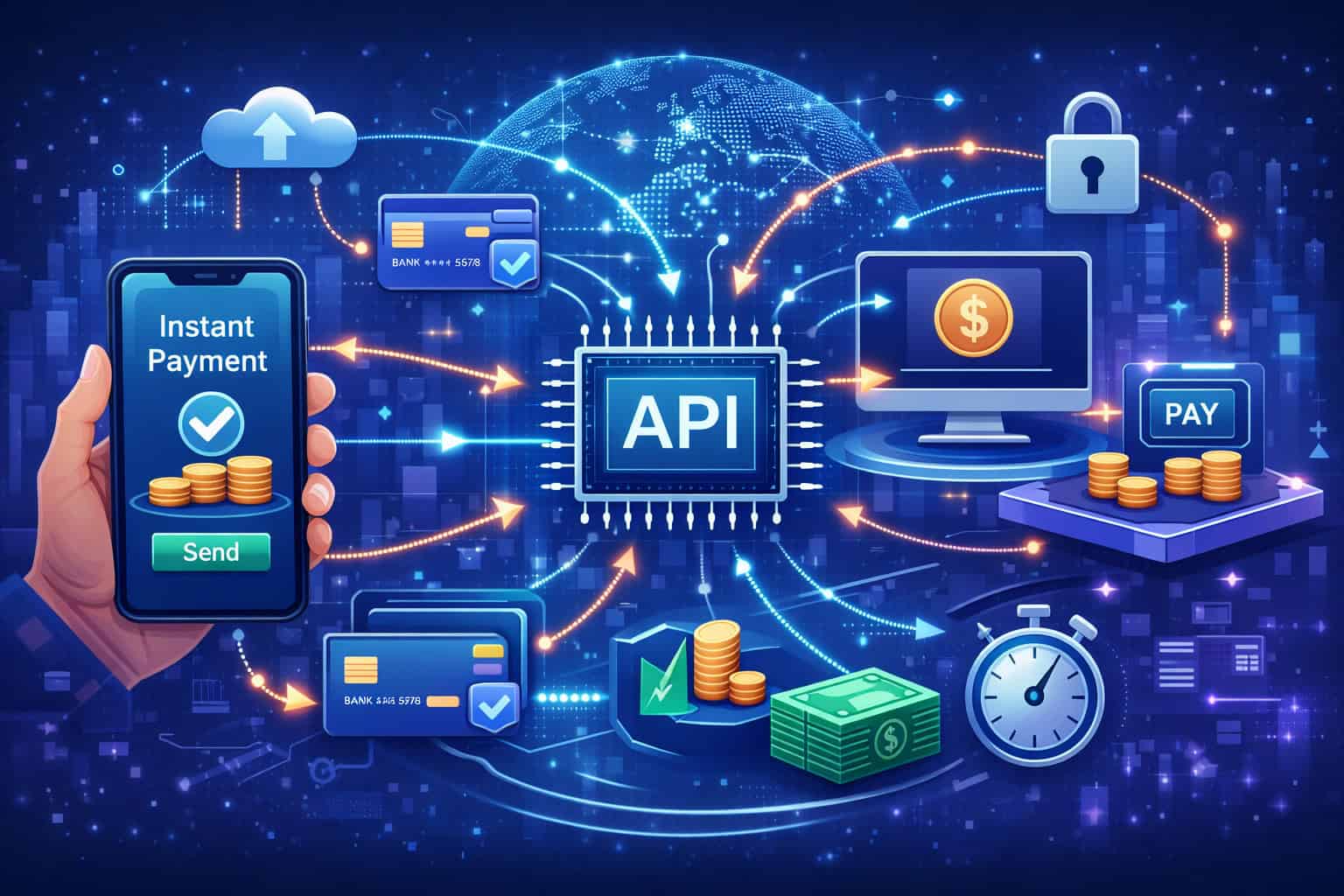
The Role of APIs in Instant Payment Systems
Instant payments have changed what customers and businesses expect from money movement: funds available in seconds, 24/7/365, with confirmation that feels as immediate as a text message.
The hidden engine behind that “it just works” experience is the API layer—software interfaces that let apps, bank cores, fraud tools, networks, and accounting systems talk to each other in real time. In modern deployments, instant payment APIs do far more than “send a payment.”
They orchestrate identity, routing, risk, message translation, compliance checks, posting to ledgers, customer notifications, and reconciliation—often across multiple providers.
The stakes are higher than in batch systems. With instant payments, the system can’t “fix it in the next file.” Availability windows are continuous. Exceptions must be handled immediately.
A single outage or ambiguous status can cascade into customer distrust, support costs, and operational risk. That’s why instant payment APIs are increasingly designed like mission-critical infrastructure: strongly authenticated, observable end-to-end, idempotent by default, and resilient to partial failures.
This guide explains how instant payment APIs fit into the full stack—from network connectivity and ISO 20022 messaging to security, fraud controls, reliability engineering, and developer experience.
It also covers where the ecosystem is heading: richer data, standardized API resources, programmable workflows, and more cross-platform interoperability. Along the way, you’ll see practical patterns you can use whether you’re building a bank channel, a payment processor platform, or a fintech application riding on top of instant rails.
Why APIs Matter in Instant Payment Systems

Instant payment systems are not just “faster ACH.” They’re a different operating model: continuous processing, immediate funds availability, and rapid confirmations that must stay consistent across many moving parts.
APIs are the glue that makes this possible. With instant payment APIs, you can translate business intent (“pay this contractor now”) into precise network messages, enforce controls (“verify recipient, run risk checks”), and return a deterministic outcome (“accepted, posted, and available”) without forcing end users to understand network complexity.
A key reason APIs matter is that instant payments typically rely on data-rich messaging. Modern networks commonly use ISO 20022 structures for payment initiation, status, and returns, enabling richer remittance and metadata.
The FedNow Service, for example, is based on ISO 20022 messages for multiple use cases (credit transfers, requests for payment, liquidity transfers, and reporting). That richness is valuable—but only if developers can access and use it easily.
Well-designed instant payment APIs turn complex schemas into clean objects, validate required fields, and preserve critical remittance detail so businesses can reconcile automatically.
APIs also matter because instant payments demand consistent behavior under pressure: retries, timeouts, and partial failures are normal in distributed systems. A payment might be accepted by your platform but awaiting a network response; your customer still needs a clear status.
A robust API surface standardizes that lifecycle, including idempotency keys, state machines, and webhooks for status transitions. In other words, instant payment APIs are not just an integration convenience—they’re the control plane that keeps real-time money movement safe, auditable, and scalable.
Finally, APIs enable choice. Many institutions connect through certified service providers and processors instead of building direct network integrations. Adoption and innovation are accelerating, with networks growing and more participants coming online.
In that environment, instant payment APIs help you abstract rails so you can add new routes and features without rewriting your product.
How Instant Payment APIs Fit Into the End-to-End Architecture
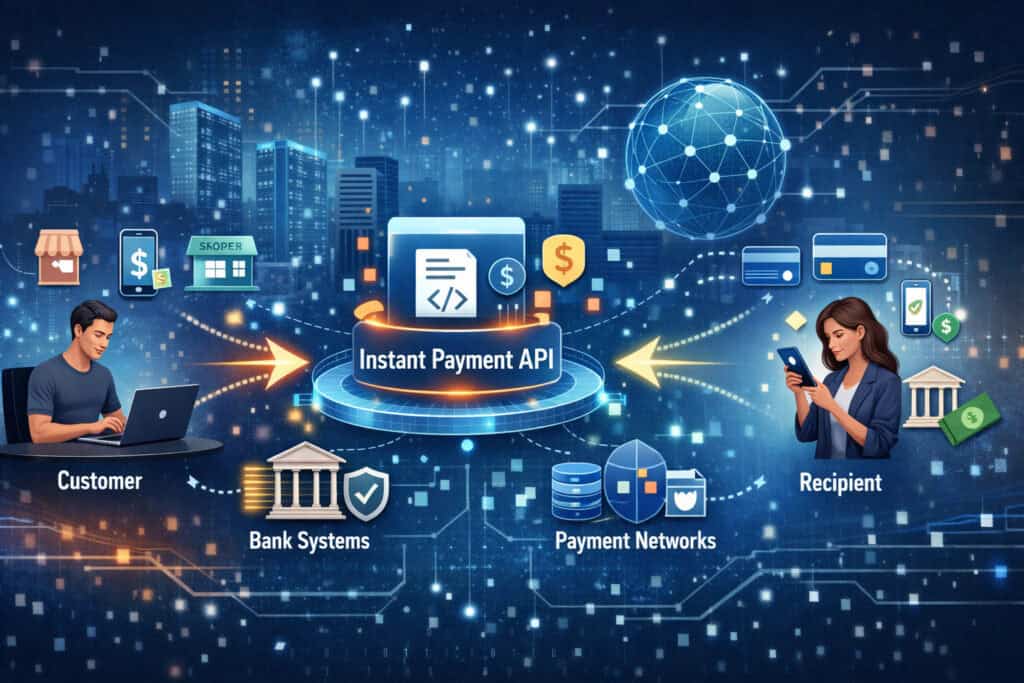
An instant payment platform usually has five layers, and instant payment APIs touch each one:
- Experience layer (channels): mobile apps, business portals, treasury dashboards, ERP plugins, call center tools. This layer calls instant payment APIs to create payees, initiate transfers, request payment, and retrieve statuses.
- Orchestration layer: the core API services that enforce business logic—limits, entitlements, fee calculation, formatting of remittance, and routing decisions. This is where instant payment APIs often implement a payment state machine (created → validated → risk-approved → submitted → accepted/rejected → posted → notified).
- Risk and compliance layer: fraud scoring, transaction monitoring, sanctions screening, and policy engines. In real time, these tools must respond within tight latency budgets. APIs coordinate synchronous checks (block/allow) and asynchronous actions (case creation, step-up verification).
- Network connectivity layer: adapters to instant rails, gateways, or processors. For ISO 20022 networks, this includes message construction, signing, transport, and parsing network responses.
The Clearing House publishes RTP message specifications defining the structure and fields supported within the RTP Network. The API layer typically shields application developers from those details. - Accounting and operations layer: ledger posting, liquidity management, reconciliation, reporting, disputes/returns workflows, and customer support tooling. Instant systems require near-real-time posting and clear audit trails. APIs make those events accessible to internal systems through webhooks, event streams, and reporting endpoints.
The “magic” is coordination: instant payment APIs align these layers so the customer sees one coherent outcome. Done well, your API becomes a stable contract even while you swap providers, add rails, or expand into new use cases like request-for-payment or instant payroll.
ISO 20022 and Data-Rich Messaging: Turning Schemas Into Developer-Friendly APIs
ISO 20022 is central to modern instant payments because it defines structured data fields for payment initiation, status updates, and additional workflows like returns and reporting.
For the FedNow Service, the Federal Reserve Banks identified specific ISO 20022 messages in scope and provided documentation describing those messages and how they support growth and innovation.
For developers, the challenge is that raw ISO 20022 messages can be verbose, deeply nested, and more “bank-native” than “app-native.” That’s where instant payment APIs become essential.
A practical approach is to treat ISO 20022 as the canonical data model—but expose a clean REST/JSON API that maps to it. For example:
- Normalize party objects (payer, payee, intermediaries) into consistent schemas.
- Preserve structured remittance information so invoices can be matched automatically.
- Validate mandatory fields early, before you hit network submission.
- Provide explicit enumerations for payment purpose codes, category purpose, and status reasons.
Another key design is handling extensions. ISO 20022 supports supplementary data to carry additional information without breaking compatibility. The ISO 20022 repository even references “business justifications for API resource development,” signaling ongoing movement toward standardized API resources in financial services. Your instant payment APIs should support extensions in a controlled way: versioned fields, explicit namespacing, and strict logging. This prevents “random metadata” from becoming a reconciliation nightmare later.
Finally, developers need lifecycle clarity. ISO 20022 networks provide status and reporting messages; your API should translate them into a small set of statuses that are easy to reason about (pending, accepted, rejected, returned) while still exposing the underlying reason codes and timestamps for audit and support.
If you do this well, instant payment APIs become the bridge between rich financial messaging and simple product experiences.
Connecting to Instant Payment Networks Using APIs
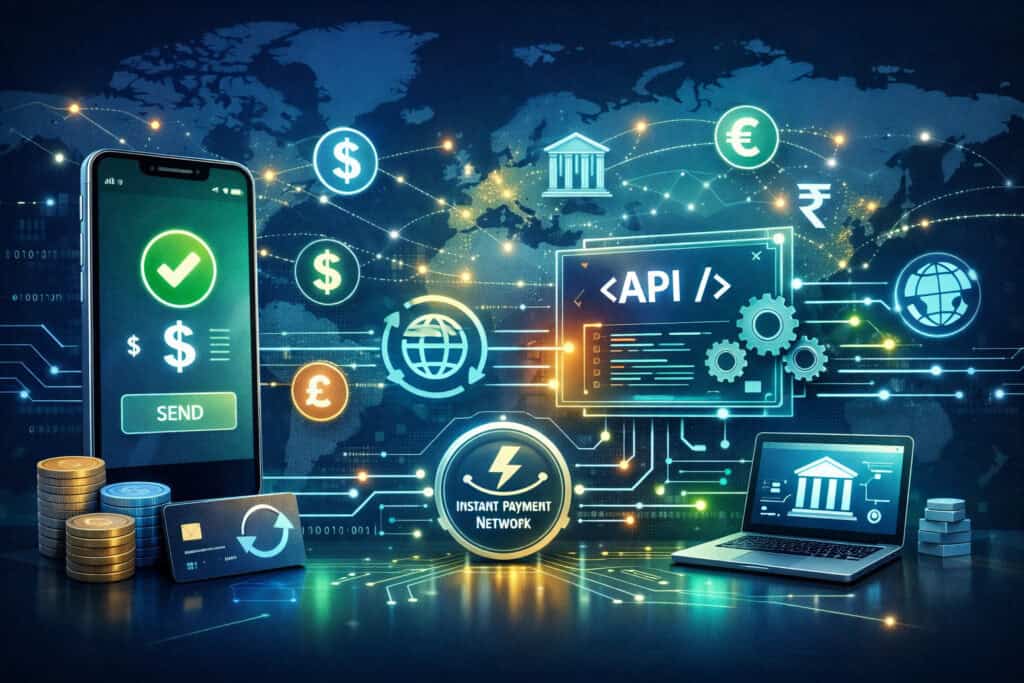
Instant payments typically move over dedicated rails that enforce rules, message formats, and operational standards. Many platforms connect indirectly through processors or certified service providers, but the core job remains the same: submit a correctly formatted instruction, receive confirmation, and post outcomes to your ledger and user experience.
In the U.S. market, the two major instant payment rails are the FedNow Service and the RTP Network. FedNow adoption has grown significantly since launch, with Federal Reserve communications noting more than 1,400 participants by mid-2025.
The RTP Network provides technical documentation describing supported message structures and fields. For builders, the important takeaway is not just that these rails exist, but that instant payment APIs can abstract rail choice while keeping consistent business semantics.
A common pattern is a rail-agnostic payment intent API (e.g., POST /instant-payments) that routes to FedNow or RTP based on recipient reachability, transaction size, policy, or cost.
Some providers also publish practical limits comparisons—one example notes per-transaction limits of $1,000,000 on FedNow and $10,000,000 on RTP (limits may change over time, so treat these as network policy, not constants). Your instant payment APIs should reflect this reality by:
- Returning an explicit rail field in responses (selected or requested).
- Validating amount constraints per rail at runtime using configurable rules.
- Supporting “reachability” checks (directory lookup) so you don’t submit to a rail the recipient can’t receive on.
- Handling irrevocability expectations with clear UX and API warnings.
When done correctly, instant payment APIs let your product evolve with the ecosystem: as more participants join, new message types roll out, and request-for-payment or additional features mature, you can expose capabilities without breaking existing integrations.
Security and Authentication Patterns for Instant Payment APIs

Because instant payments can be irrevocable and immediate, security for instant payment APIs must be stricter than “typical web app” security. Attackers love speed: if they can initiate and confirm within seconds, recovery options shrink. That means authentication, authorization, and integrity controls should be layered.
At the transport level, many implementations use mTLS (mutual TLS) between clients and API gateways for strong client identity, especially for B2B integrations and service-to-service calls.
On top of that, OAuth 2.0 with scoped access tokens is common for end-user delegated access, while signed JWTs or HMAC signatures are used for server-to-server requests where non-repudiation matters.
Your instant payment APIs should also support fine-grained scopes: initiating payments, managing beneficiaries, viewing balances, approving transactions, and retrieving reports should not share the same permission.
Integrity is equally important. Require idempotency keys for payment creation to prevent duplicate submissions during retries. Sign request payloads for high-risk operations, and log the signature verification outcome.
Consider step-up authentication (e.g., OTP, device binding, or risk-based MFA) for new beneficiaries, first-time payees, or payments above thresholds. Enforce allowlists for destination accounts or beneficiary verification flows where appropriate.
Operationally, key management must be professional-grade: rotate keys, use hardware security modules where feasible, and separate duties so no single operator can both change routing rules and approve withdrawals.
Rate limiting and anomaly detection belong at the edge. Most importantly, your instant payment APIs should make secure behavior the default—so partner developers don’t have to “remember” to do the right thing.
Fraud, Compliance, and Risk Controls Through APIs
Fraud controls in instant payments are an API problem because the decision loop must complete in milliseconds to seconds, without human review, while still meeting compliance obligations.
The best platforms treat risk as a real-time orchestration pipeline where instant payment APIs coordinate multiple signals: device reputation, beneficiary age, behavioral analytics, velocity limits, account history, and external data checks.
A strong baseline is multi-layer validation:
- Pre-initiation controls: beneficiary verification, account ownership checks (where available), and entitlement controls (who can send, how much, to whom).
- Initiation controls: sanctions screening, transaction monitoring rules, and fraud scoring. If the risk score is borderline, trigger step-up verification before submission.
- Post-submission controls: event monitoring and automated case generation for suspicious patterns, even if the transaction completed, to stop future attempts.
Instant rails also support richer message content and structured remittance. That data can help spot anomalies (e.g., mismatched invoice references, unusual purpose codes, or altered beneficiary details). The more your instant payment APIs preserve structured data, the better your monitoring becomes.
Compliance requirements vary by institution type and program design, but common needs include audit logs, immutable event trails, and reproducible decisions (“why was this allowed?”). Build your APIs so every payment has:
- A unique correlation ID
- Full timestamped state transitions
- Captured risk inputs and outputs (with privacy controls)
- Linked screening and monitoring outcomes
The goal is not to “block everything.” It’s to enable safe speed. Well-designed instant payment APIs help you tune friction intelligently: low-risk flows remain instant, while high-risk flows become secure by design.
Reliability Engineering: Making Instant Payment APIs Work 24/7/365
Instant payments don’t pause for weekends, holidays, or batch windows—so your platform can’t either. Reliability is not a backend concern; it’s a product feature. The most important reliability concept for instant payment APIs is idempotency: clients must be able to retry safely when they don’t know what happened.
Every payment initiation endpoint should accept an idempotency key and return the same outcome for the same key, even if the first attempt partially succeeded.
Next is a clear state model. You need unambiguous transitions like:
- validated
- risk_approved
- submitted_to_rail
- accepted
- rejected
- posted
- returned (if applicable)
Expose this model consistently in instant payment APIs and publish webhook events for transitions. That way, clients don’t poll aggressively, and internal tools can reconcile automatically.
Observability is the third pillar. For each payment, you should trace:
- API request latency and errors
- Risk service timings
- Network submission and response times
- Ledger posting outcomes
- Notification delivery
Because ISO 20022 networks provide structured responses and reason codes, store them and surface them to support and partners in a controlled way. If a network is intermittently slow, your API can return “submitted” with a follow-up webhook when the final status arrives—without leaving customers guessing.
Finally, plan for graceful degradation. If a downstream fraud system is unavailable, you should have policy-driven behavior: fail closed for high-risk use cases, fail open for low-risk internal transfers, or route to manual review for business payments.
The key is that instant payment APIs must behave predictably under stress, because unpredictability is what breaks trust.
Core Instant Payment API Use Cases That Drive Adoption
Instant payment systems succeed when they solve real problems better than legacy methods. The most valuable instant payment APIs are designed around concrete use cases, not just “send money fast.”
Real-time disbursements are a top driver: insurance payouts, marketplace seller earnings, gig worker compensation, and refunds. The value is immediate funds availability and reduced customer support (“where is my money?”).
Instant payment APIs here must support beneficiary management, compliance checks, and rich remittance so recipients know what the payment is for.
Instant payroll is another high-impact use case: earned wage access, off-cycle payroll, and same-day contractor payments. Adoption narratives increasingly highlight these innovations and the ecosystem growth around them.
In payroll flows, APIs need strong identity controls, cut-off independence, and predictable posting confirmation.
Bill pay and request-for-payment workflows become powerful when the message carries invoice detail and the payer can approve in real time.
ISO 20022 enables structured references and richer interactions, and industry commentary notes request-for-payment capabilities being developed across instant ecosystems. For these flows, instant payment APIs should support creation of payment requests, expiry, partial payments if allowed, and automated reconciliation.
Treasury and B2B use cases focus on cash positioning, supplier payments, and just-in-time funding. Here, the API must provide reporting, liquidity management hooks, and integration into ERP systems.
The more your instant payment APIs support metadata and event streaming, the more businesses can automate without manual matching.
Designing Instant Payment APIs for Developers and Partners
Developer experience often determines whether instant payment capabilities turn into real volume. If integration is slow, partners stick with older rails. The best instant payment APIs feel like modern developer platforms: consistent resources, predictable errors, excellent documentation, and safe sandboxes.
Start with a stable resource model:
- beneficiaries
- accounts
- instant_payments
- payment_requests
- returns / refund_requests
- events and webhooks
Make error messages actionable. For ISO 20022-backed systems, provide both a human message (“missing beneficiary address”) and a machine reason code that maps to the underlying validation.
If your platform uses external conformance testing, expose that pathway. FedNow documentation references message specifications and testing resources hosted on industry tooling platforms, and readiness materials emphasize being able to validate message compliance.
Webhooks are essential. Polling is costly and fragile; event-driven integrations are better. Your instant payment APIs should support webhook signing, replay protection, and event versioning. Provide a dashboard for replaying failed webhooks and correlating events to payment IDs.
Finally, invest in partner tooling: Postman collections, SDKs, sample code, and integration guides for common stacks (ERP, accounting, marketplaces). If partners can go from “hello world” to “first payment” quickly, you’ll win mindshare—and volume.
Future Predictions: Where Instant Payment APIs Are Headed
The next phase of instant payments isn’t just faster transfers—it’s smarter payments. Three trends will shape the evolution of instant payment APIs.
- More standardization at the API layer: ISO 20022 already standardizes messages, and the ISO repository’s inclusion of “API resource development” points toward growing alignment between message standards and API resource standards.
Expect more shared patterns for endpoints, fields, and event semantics, reducing custom integrations across providers. - Richer data and automation as default: As businesses demand reconciliation-ready payments, instant payment APIs will increasingly require structured remittance, invoice identifiers, and purpose metadata.
That will unlock straight-through processing: automatic posting into accounting systems, automated exception handling, and fewer “unidentified deposit” cases. - Risk controls that are adaptive and AI-assisted: Fraud will keep evolving, and instant payment platforms will respond with real-time models, graph analytics, and adaptive friction (step-up only when needed).
The API surface will expand to include “explainability” signals—why a payment was challenged—so partners can design better UX.
We’ll also see more multi-rail orchestration: instant rails for speed, ACH for cost, wires for specific high-value needs, all behind one intent-based API. Over time, instant payment APIs will look less like “payments endpoints” and more like programmable money movement workflows.
FAQs
Q.1: What are instant payment APIs, and how are they different from traditional payment APIs?
Answer: Instant payment APIs are interfaces that initiate, manage, and confirm payments that settle and become available in near real time, typically within seconds, and operate continuously.
Traditional payment APIs often assume batch processing (like file-based systems), delayed settlement, and looser timing guarantees. The difference shows up in the entire lifecycle: instant flows need immediate validation, synchronous risk decisions, fast network submission, and rapid confirmation, all wrapped in a developer-friendly contract.
Another major difference is data structure. Instant rails commonly rely on ISO 20022 messages that carry rich, standardized fields for parties, remittance, and statuses.
Systems like the FedNow Service use ISO 20022 message types for multiple workflows, and networks publish detailed message specifications. Instant payment APIs translate those message structures into simple objects and stable endpoints, while preserving the richness that businesses need for reconciliation.
Finally, instant systems require higher resilience. Retries must not create duplicates, so idempotency is foundational. Status models must be explicit, and event delivery (webhooks) is usually a first-class feature. In short: instant payment APIs are designed for speed and certainty, not just connectivity.
Q.2: How do instant payment APIs handle ISO 20022 without forcing developers to learn XML?
Answer: Most developers prefer JSON and REST, while ISO 20022 is frequently represented as XML schemas. The standard approach is mapping: your platform keeps a canonical ISO 20022 model internally, then exposes a JSON-based API surface that mirrors the important business concepts.
FedNow readiness materials describe ISO 20022 messages in scope and emphasize standardized structures that support innovation.
Good instant payment APIs avoid “leaky abstractions.” Developers shouldn’t need to know the difference between message families (like pacs or camt) to send a payment.
Instead, they provide resources like instant_payments and events, while still offering advanced fields for teams that want them. Validation happens early: required fields, format constraints, and policy rules are checked at the API boundary.
At the same time, the best platforms preserve ISO advantages: structured remittance, reason codes, and supplementary data for extensibility. The result is an API that feels modern while retaining the interoperability and data quality benefits that ISO 20022 brings to instant ecosystems.
Q.3: What security controls are most important for instant payment APIs?
Answer: Because instant payments can be hard to reverse, security must be layered. Start with strong client authentication (mTLS for B2B and service-to-service), scoped authorization (OAuth 2.0 tokens with least privilege), and payload integrity (signed requests for high-risk operations).
Instant payment APIs should enforce idempotency keys to prevent duplicate payments under retry conditions, and should rate-limit initiation endpoints to reduce automated abuse.
Next, focus on beneficiary security: adding or changing payees is a common fraud path. Apply step-up authentication for new payees, impose cooling-off rules for high-risk segments when appropriate, and monitor changes as high-signal events.
Also separate duties: the identity that updates routing or limits should not be the same identity that initiates high-value payments.
Finally, invest in operational security: key rotation, secrets management, strict logging, and continuous monitoring. Because these systems run 24/7/365, incident response must also be continuous. Security isn’t a “one feature” add-on; for instant payment APIs, it’s part of the platform contract.
Q.4: What do “idempotency” and “payment state machines” mean in instant payment APIs?
Answer: Idempotency means a client can safely retry a request without causing unintended duplicates. In instant payments, network timeouts and transient failures happen; the client might not know if the payment was created.
Instant payment APIs solve this with an idempotency key: if the same key is reused, the API returns the original result rather than creating a new payment.
A payment state machine is the formal model of how a payment progresses from request to completion. Instead of a vague “processing” status, you define discrete steps such as validated, risk-approved, submitted, accepted, rejected, posted, and returned.
This is crucial because instant ecosystems provide fast but multi-stage outcomes: a payment can be accepted by a rail but still needs ledger posting and notifications.
When APIs expose the state machine clearly (and publish events through webhooks), integrators can build reliable UX and accounting flows. This is why idempotency and state machines are foundational design principles in instant payment APIs, not optional technical details.
Q.5: How do instant payment APIs support reconciliation and accounting automation?
Answer: Reconciliation is where instant payments deliver huge value—if the data is carried correctly. ISO 20022 supports structured remittance and references, and networks built on ISO 20022 enable richer information exchange than older batch formats. Instant payment APIs should preserve that structured data instead of flattening everything into a single memo field.
Practically, this means your API should accept invoice identifiers, line-item references (where supported), and standardized purpose fields. It should also return network reason codes and timestamps so accounting systems can match events precisely.
For businesses, the combination of structured remittance plus real-time confirmation enables straight-through posting: as soon as “accepted and posted” occurs, the ERP can mark an invoice paid and release goods or services.
In addition, expose reporting endpoints and event streams so finance teams can reconcile without manual exports. When instant payment APIs treat reconciliation as a first-class use case, they reduce support tickets, shorten days-sales-outstanding, and improve customer trust.
Q.6: What’s the outlook for instant payment APIs over the next 3–5 years?
Answer: Over the next few years, instant payment APIs will become more standardized, more data-rich, and more workflow-oriented.
First, expect broader alignment between message standards and API resources—ISO 20022 already includes references to API resource development, hinting at growing standardization beyond XML messages. This will reduce bespoke integrations and help platforms interoperate more easily.
Second, richer data will become the default expectation. As instant rails mature and adoption grows, more products will use structured remittance and request-for-payment experiences to automate billing and reconciliation.
Third, fraud and compliance will become more adaptive: real-time models, shared signals, and dynamic step-up flows will be built directly into the API experience.
Finally, multi-rail orchestration will expand. Many platforms will treat “instant” as a capability, not a single rail—routing across options based on reachability, transaction size, and policy. The winners will be the teams that build instant payment APIs as stable contracts with strong observability, security, and extensibility.
Conclusion
APIs are the operational backbone of instant payment systems. Without instant payment APIs, real-time rails would remain difficult to use, hard to secure, and expensive to integrate.
With them, instant payments become programmable: apps can initiate transfers, attach reconciliation-ready data, enforce risk controls in milliseconds, and deliver confirmed outcomes that users trust.
The most effective approach is to treat the API layer as a product and a control plane. Map ISO 20022 richness into developer-friendly resources, connect reliably to rails with clear state models, and build security and idempotency into the contract.
Use eventing and webhooks so integrations are resilient and scalable. Design for continuous operations, because instant payments never “close.”
Looking forward, instant payment APIs will move beyond “send money” into richer workflows: request-for-payment, automated reconciliation, smarter fraud controls, and more standardized API resources across the ecosystem.
Teams that invest now in clean abstractions, strong observability, and data-first design will be best positioned to ship new instant payment products quickly—while keeping safety, compliance, and user experience at the center.