Tokenization in Instant Payments: How It Keeps You Secure
Instant payments are built for speed: money moves in seconds, around the clock, with immediate confirmation. That convenience is also what makes security non-negotiable.
If attackers can steal account details, hijack sessions, or replay payment messages, the “instant” part works against victims—because there’s less time to detect, stop, and recover.
This is where tokenization becomes one of the most practical security upgrades in modern payments. Instead of sending real account credentials (like a card number or bank account number) through every app, API, database, and message path, tokenization replaces them with a substitute value (a token) that is useless if stolen.
The real credential stays protected in a secure environment, and only authorized systems can map the token back to the original value.
Tokenization is already proven in the card world through EMV Payment Tokenization, which replaces valuable card data with payment tokens while keeping compatibility with existing acceptance infrastructure.
And it’s increasingly expanding to instant payment rails and bank-to-bank ecosystems as networks introduce token services that keep tokens intact through the payment journey until detokenization at controlled points.
In this guide, you’ll learn how tokenization works in instant payments, where it fits in the security stack, how it reduces fraud, and what the future looks like as token services, identity controls, and real-time rails keep evolving.
What Tokenization Really Means in Instant Payments
Tokenization is often described as “replacing sensitive data with a random value,” but in instant payments it’s more helpful to think of tokenization as credential minimization.
The goal is to ensure that the systems most exposed to risk—apps, browsers, APIs, customer support tools, merchant environments, logs, analytics pipelines—never need to store or transmit the real credential.
A token is typically a surrogate identifier that looks like a credential (sometimes formatted similarly) but has no exploitable meaning on its own.
The token only becomes useful when combined with controlled access to a token vault (or token service) that can map tokens to the real underlying value. That mapping is governed by cryptographic controls, policies, and audit trails.
In instant payments, tokenization can protect:
- Bank account numbers used for pay-by-bank or account-to-account transfers
- Card credentials used to fund real-time disbursements
- Payment addresses (like alias-based routing)
- API credentials and session-bound payment authorizations
- Recipient identifiers and sensitive reference data
Network-level token services are gaining momentum because they reduce exposure across the full transaction path. The Clearing House, for example, describes network tokenization as keeping tokens intact through the journey until detokenization at the network, enabling bank-defined rules.
Tokenization vs. Encryption vs. Masking
Tokenization is not the same as encryption, and confusing them can lead to weak designs.
- Encryption transforms data using a key; if someone steals encrypted data and the key (or can break key management), the original data can be recovered. Encryption is essential—especially “in transit” and “at rest”—but it doesn’t automatically reduce how many places the real credential exists.
- Masking hides part of the value (like showing only the last four digits). It helps limit casual exposure, but masked data often still reveals patterns and may still be sensitive under compliance rules.
- Tokenization aims to ensure the real credential is not present in most systems at all. That drastically shrinks what attackers can steal and where compliance scope exists. It also enables rapid credential replacement: a token can often be re-issued without closing the underlying account, reducing disruption.
Why Instant Payments Need Tokenization More Than Ever
Instant payments change the security equation. Traditional batch or next-day systems gave banks and payment providers extra time to run fraud scoring, hold transactions, and investigate anomalies. Real-time rails compress decision windows to seconds, and funds availability is immediate.
That creates four big pressures:
1) Faster fraud attempts: Fraudsters optimize for speed. If they gain access to an account credential or a payment authorization path, they can move money instantly and potentially launder it through mule networks before alarms fire.
2) Higher impact of data breaches: When raw account numbers or payment credentials leak, attackers can monetize them across multiple channels—API abuse, ACH-based fraud, account takeover, social engineering, and onboarding scams. Tokenization reduces the blast radius because stolen tokens are less reusable outside the intended context.
3) More endpoints and integrations: Instant payments rely on APIs, mobile apps, digital wallets, fintech partners, bill pay integrations, and open banking data flows. Every integration increases exposure. Tokenization gives you a consistent method to protect credentials across those integrations.
4) More compliance complexity: As rules tighten, evidence requirements increase. For example, PCI Security Standards Council publishes PCI DSS v4.0.1 and related guidance as organizations modernize controls and validation. Tokenization—implemented correctly—can reduce exposure and simplify what systems fall into strict compliance scope.
In short: instant payments demand security-by-design, and tokenization is one of the strongest “design” moves you can make.
The threat model tokenization helps address
Tokenization is not a magic shield, but it’s extremely effective against common real-time payment threats such as:
- Credential stuffing and account takeover: tokens reduce the value of stolen stored credentials
- Database breaches: tokens in databases limit monetization of stolen data
- API scraping and logging leaks: tokens minimize what ends up in logs and analytics
- Merchant environment compromise: tokens prevent downstream systems from seeing raw data
- Replay attacks (with proper token design): tokens can be single-use or time-bound
- Insider risk: tokens reduce what internal roles can view or misuse
Where Tokenization Fits in the Instant Payments Stack
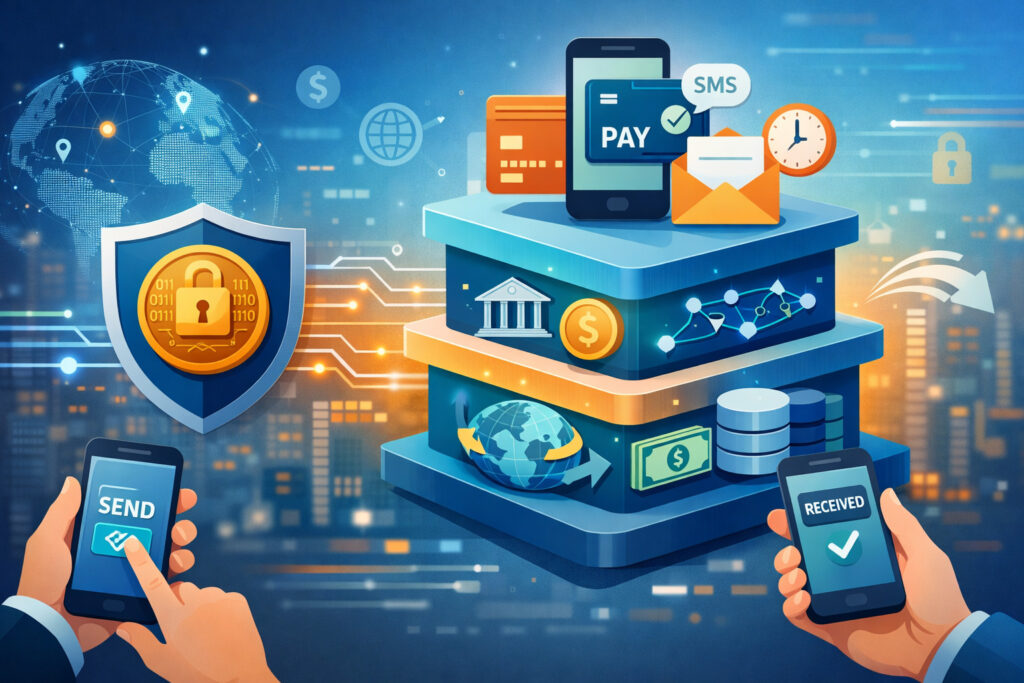
To implement tokenization well, you need to know where sensitive data appears across the transaction lifecycle. In instant payments, there are multiple layers:
- Customer layer: mobile apps, web apps, wallets, corporate portals
- Merchant/acceptance layer: checkout flows, invoicing, pay links, POS, ERP integrations
- Gateway/API layer: payment initiation APIs, partner APIs, webhooks
- Processing layer: routing, validation, risk checks, orchestration
- Network/rail layer: message formats, clearing, settlement, confirmations
- Bank core layer: accounts, ledger, limits, fraud engines, compliance tooling
Tokenization can happen at several points, and each option has tradeoffs.
- Client-side tokenization reduces exposure earliest, but requires robust device binding and secure SDKs.
- Merchant/acquirer tokenization protects merchant environments and reduces stored credential risk.
- Network-level tokenization protects data across broader ecosystems and can standardize how tokens flow end-to-end—reducing fragmentation and enabling bank-defined controls.
- Issuer/bank tokenization can integrate directly into core account systems, but must be carefully scoped to avoid operational bottlenecks.
A practical approach is to combine them: tokenize early, keep tokens moving through the flow, and detokenize only inside tightly controlled zones.
A simple mental model: “Token everywhere, detokenize almost nowhere”
A strong tokenization architecture follows three principles:
- Minimize detokenization events (each one is a high-risk moment)
- Minimize who can request detokenization (strict service-to-service authorization)
- Minimize where the token vault is reachable (network segmentation + hardened access)
This is how you keep instant payments fast and secure—by shrinking what systems can possibly leak.
How Tokens Are Created, Stored, and Mapped Securely
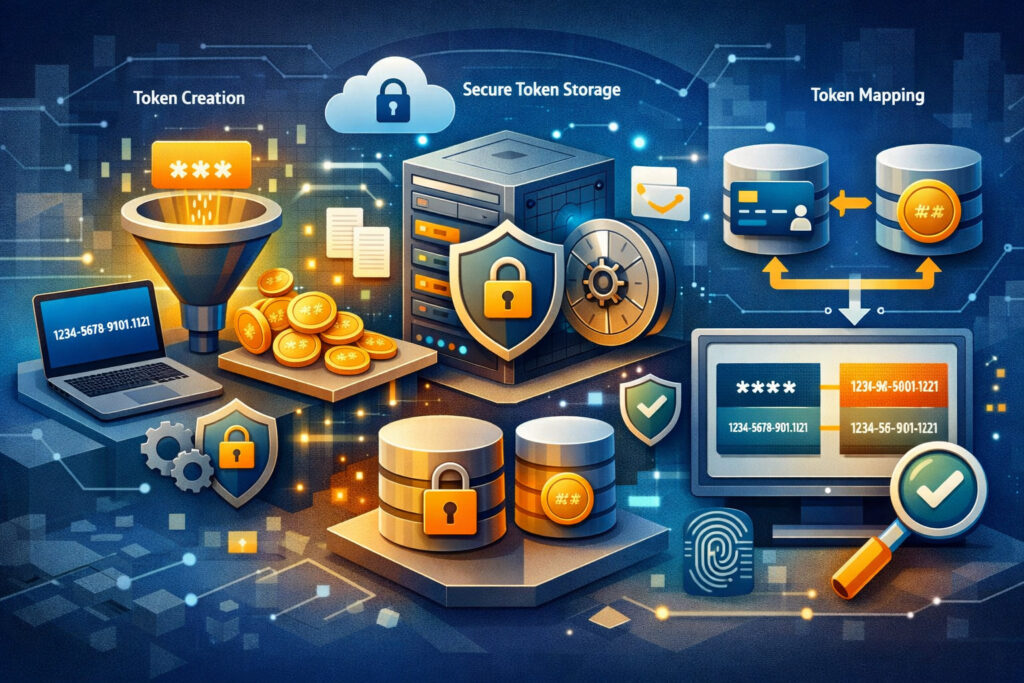
A token is only as strong as the system that issues and resolves it. Secure tokenization requires robust controls around issuance, storage, and mapping.
Most tokenization systems include:
- Token generation: creating unpredictable tokens with strong randomness
- Vaulting / mapping: securely storing token-to-credential relationships
- Policy engine: rules for where tokens can be used and when to detokenize
- Access control: authentication, authorization, and service identity validation
- Audit logging: immutable records for compliance and investigations
- Key management: protecting secrets, certificates, and encryption keys
High-quality token services can enforce contextual rules. Network-level token services, for example, may support bank-defined rules and controlled detokenization points.
Vault-based vs. vaultless tokenization
Vault-based tokenization stores mappings in a secure repository. It’s flexible and supports lifecycle controls (re-issuing tokens, revoking tokens, adding metadata). It can also support multi-channel use cases: wallet tokens, pay-by-bank tokens, merchant tokens.
Vaultless tokenization often uses cryptographic techniques where detokenization is computed rather than looked up. This can scale well, but policy enforcement and revocation can be more complex.
For instant payments, vault-based tokenization is common because:
- it supports revocation in real time
- it supports token lifecycle management
- it supports multi-party ecosystems where different systems need different privileges
Token metadata and the “least disclosure” principle
Tokens can carry metadata in a controlled way—like issuer identifiers, merchant context, or token type—without exposing the underlying credential. But teams must be careful: tokens should not become a new identifier that enables tracking or privacy leakage.
A secure approach uses:
- minimal metadata on the token itself
- richer metadata stored securely in the vault
- strict rules for what downstream services can query
Tokenization and Authentication: Making Sure the Right Person Initiates the Payment
Tokenization protects credentials, but instant payments also need strong authentication and authorization controls. If attackers can impersonate the user or the business, they can initiate payments using valid tokens.
This is why modern real-time systems combine tokenization with:
- device binding
- strong customer authentication (MFA, risk-based, passkeys where supported)
- session security (short-lived tokens, secure cookies, anti-CSRF)
- API authorization (OAuth scopes, signed requests, mTLS for server-to-server)
Some real-time rails emphasize cryptographic protections at the message level as well. For example, FedNow readiness guidance highlights encryption at rest and in transit and includes message signing details that participants must manage with keys and digital certificates.
Tokenization fits here by reducing what authentication systems must protect. If your system never stores raw credentials, a successful account takeover has less value unless the attacker also compromises authorization layers—which should be hardened and monitored.
Preventing “token theft” scenarios
Even though tokens are safer than raw credentials, they can still be abused if stolen. So token systems often include:
- Domain restrictions: token works only for specific merchants/apps
- Channel restrictions: token works only for mobile app vs. web
- Time limits: token expires quickly for high-risk flows
- One-time-use tokens: for sensitive actions like adding a payee
- Velocity limits: token can’t initiate unlimited payments
- Risk-based step-up: prompt MFA when behavior changes
In instant payments, these controls are essential because you cannot rely on long settlement windows to catch fraud later.
Tokenization Across Real-Time Rails
Instant payments typically ride over specialized networks and messaging standards. Tokenization is increasingly being applied at the network and ecosystem level so that account identifiers are protected even as messages traverse multiple participants.
Two common patterns are emerging:
1) Account tokenization for bank-to-bank payments
Instead of sharing raw account numbers, systems use tokens that represent accounts. A network-level token service can keep tokens intact through the journey and detokenize only at controlled points. This is particularly useful in open banking-like scenarios where many fintech apps need to initiate payments without storing account numbers.
2) Card tokenization for real-time disbursements and push payments
Card ecosystems have long supported tokenization, and EMV Payment Tokenization is a widely recognized approach that replaces valuable card data with payment tokens to increase security. Even when money movement is “instant,” the funding or credential layer may still rely on tokenized card data.
The best strategy is to treat tokenization as a cross-rail security layer. Whether the underlying movement uses an instant rail, a card push, or another scheme, the credential should remain tokenized wherever possible.
Tokenization improves dispute handling and servicing, too
Security isn’t the only win. Tokenization can reduce operational pain:
- fewer account re-issues after breaches
- safer customer support (agents see tokens, not raw numbers)
- easier partner onboarding (partners never handle sensitive data)
- better fraud analytics (tokens can be consistent identifiers without exposing credentials)
Network operators and industry ecosystems are pushing this direction because it supports both innovation and risk reduction.
Compliance and Risk: How Tokenization Supports Security Requirements
Tokenization is often implemented for security reasons first, but it also helps with compliance, audits, and governance—especially when organizations must prove they reduce exposure of sensitive payment data.
For payment card environments, PCI Security Standards Council publishes PCI DSS v4.0.1 and supporting documents, reflecting the shift toward more modern security expectations and evidence-driven validation.
While tokenization doesn’t replace security controls, it can reduce the number of systems that store or process raw credentials—shrinking audit scope and limiting breach impact.
For real-time rails, security guidance emphasizes encryption, key/certificate management, and message integrity. FedNow’s readiness material, for example, notes encryption at rest and in transit and describes message signing requirements that participants must manage through keys and digital certificates.
Tokenization complements those measures by reducing sensitive data exposure even if transport encryption is correctly implemented.
Tokenization is not a compliance shortcut
A common mistake is assuming tokenization automatically removes all obligations. In reality:
- If your system can detokenize, it’s still highly sensitive.
- If tokens are reversible and broadly usable, they may be treated as sensitive data.
- You still need access controls, monitoring, logging, vulnerability management, and incident response.
But tokenization can materially improve your risk posture when combined with:
- network segmentation around vault systems
- strict service identity and authorization
- strong key management and rotation
- continuous monitoring and alerting
- regular access reviews and auditing
Think of tokenization as a “scope reducer” and “blast-radius reducer,” not a replacement for security fundamentals.
Implementation Playbook: How to Roll Out Tokenization Without Breaking Speed
Tokenization projects succeed when teams design for performance, developer usability, and lifecycle operations—not just cryptography.
A practical rollout plan looks like this:
Step 1: Map sensitive data flows
List every place credentials appear: frontend forms, API payloads, logs, databases, message queues, third-party integrations, support tooling, analytics.
Step 2: Decide tokenization points
Tokenize as early as feasible, and detokenize as late as possible. If you have multiple channels (mobile, web, partner APIs), standardize token usage across them.
Step 3: Choose your token service model
You can use:
- a dedicated internal token vault (hardened service + HSM-backed key management)
- a network token service (where available) that carries tokens through the ecosystem
- a hybrid approach for different credential types
Step 4: Add policy controls
Enforce token usage rules: merchant binding, channel binding, expiration, velocity limits, and risk-based step-up.
Step 5: Modernize authentication and message integrity
Use strong customer authentication and secure service-to-service controls. In instant rails, ensure encryption and signing requirements are met.
Step 6: Operationalize lifecycle management
Plan for:
- token rotation and replacement
- revocation after fraud or customer requests
- incident response procedures
- reporting and audit evidence
Tokenization should make instant payments safer without adding noticeable latency. When designed well, tokens can be resolved in milliseconds, and most systems never touch raw credentials.
Common pitfalls to avoid
- Over-detokenization: pulling raw credentials into too many internal services
- Weak service authorization: letting too many systems request detokenization
- Leaky logs: accidentally logging raw data before tokenization
- Poor revocation design: failing to invalidate tokens quickly after risk events
- Token reuse across contexts: letting the same token work everywhere, forever
Avoid these, and tokenization becomes an accelerator—not a bottleneck.
Fraud Reduction: What Tokenization Stops and What It Doesn’t
Tokenization is powerful, but it’s not a complete fraud solution. The best programs understand what tokenization blocks directly, what it reduces indirectly, and what other controls must cover.
What tokenization helps stop directly
- Data-breach monetization: If attackers steal a merchant database full of tokens instead of raw credentials, the stolen dataset is far less valuable.
- Credential replay across channels: If tokens are domain-bound or channel-bound, attackers can’t reuse them outside the approved context.
- Insider misuse: Tokens reduce what internal users can view. Combined with role-based access and monitoring, this helps prevent improper access.
- Third-party risk: Partners and vendors can process tokens without ever storing the real credential.
Network-level token services emphasize that keeping tokens intact through the journey improves security because sensitive account data is minimized across participants.
What tokenization does not solve alone
- Authorized push payment scams: If a customer is tricked into sending money to a fraudster, tokenization won’t stop it. You need confirmation-of-payee style checks, behavioral risk scoring, and user education.
- Account takeover: If attackers log in as the user, they can use tokens legitimately. You need strong authentication, device risk signals, and anomaly detection.
- Mule networks and laundering: Real-time money movement requires monitoring recipient risk, velocity patterns, and network-wide intelligence.
Tokenization should be viewed as a foundational control that makes other defenses stronger—especially in instant payments where response time is limited.
Future Predictions: Where Tokenization in Instant Payments Is Headed
Tokenization is moving from a “security feature” to a platform capability. Over the next few years, expect several trends to become mainstream:
1) Network token services expand for account-to-account ecosystems
As adoption grows, more instant payment participants will rely on network token services to protect account identifiers and support open banking-style initiation. The Clearing House has publicly discussed its Token Service and the security benefits of keeping tokens intact until controlled detokenization.
2) More programmable token rules
Tokens will carry enforceable policy: where they can be used, transaction limits, time windows, device requirements, and step-up triggers.
3) Identity-bound tokens
Instead of treating tokens purely as credential substitutes, systems will tie tokens to verified identities and device posture. That will reduce fraud from stolen data alone.
4) Stronger cryptography and post-quantum readiness
As cryptographic guidance evolves, token services will increasingly adopt crypto agility: the ability to upgrade algorithms and rotate keys without downtime.
5) Privacy-preserving analytics
Tokens will be used to enable fraud screening and monitoring without exposing raw credentials—similar to how EMV tokenization supports value-added services while protecting payment data.
Instant payments will keep scaling. The security winners will be the systems that reduce credential exposure so effectively that even major breaches don’t create catastrophic downstream fraud.
FAQs
Q.1: Is tokenization safe enough for instant payments that settle in seconds?
Answer: Yes—when designed correctly, tokenization is one of the best security controls for instant payments because it reduces exposure of sensitive credentials across fast-moving systems.
The key is minimizing detokenization and controlling who can request it. Tokens should be bound to context (merchant, channel, device, or use case) and backed by strict authorization, monitoring, and audit logging.
Also remember: tokenization is strongest when combined with transport security and message integrity. Real-time rails often require encryption and message signing controls that participants must manage using keys and certificates.
Tokenization doesn’t replace those controls—it complements them by ensuring that even if logs leak or a third-party integration is compromised, attackers don’t automatically obtain raw account credentials.
Q.2: What’s the difference between network tokenization and merchant tokenization?
Answer: Merchant tokenization typically protects data within a merchant or payment facilitator environment, replacing raw credentials before storing them in merchant systems.
Network tokenization aims to protect data across the broader payment ecosystem, so tokens remain intact through routing and processing until they reach a controlled detokenization point.
Network-level token services can be especially helpful for instant payments, where many parties touch the transaction path. Some networks describe keeping tokens intact throughout the journey and detokenizing only at the network, enabling bank-defined rules.
Merchant tokenization is still valuable, but network tokenization can reduce exposure across many more participants.
Q.3: Does tokenization eliminate the need for encryption?
Answer: No. You still need encryption in transit and at rest, along with strong key management, segmentation, and monitoring. Tokenization reduces how many places the real credential exists; encryption protects data where it must exist or transit.
In real-time payments programs, encryption and authentication are typically foundational expectations. For example, FedNow readiness materials emphasize encryption at rest and in transit and include message signing guidance with key pair management.
Tokenization works best on top of those controls—together they reduce both interception risk and breach monetization risk.
Q.4: Can tokenization help reduce compliance scope?
Answer: Often, yes—tokenization can reduce how many systems store or process raw payment credentials, which can shrink audit scope and reduce breach exposure. But it depends on implementation. If systems can detokenize freely, they may still be treated as highly sensitive.
PCI Security Standards Council continues to publish PCI DSS v4.0.1 and supporting documents that reflect modern control expectations and evidence requirements.
Tokenization can support compliance efforts, but it’s not a substitute for required security controls. Think of it as a way to reduce exposure and simplify architecture, not as a compliance loophole.
Q.5: What’s the biggest mistake teams make when implementing tokenization?
Answer: The most common mistake is detokenizing too often. Teams tokenize data, but then pull the raw credential back into multiple internal services “for convenience”—which recreates the original risk.
A better model is: tokenize early, keep tokens everywhere, and detokenize only inside tightly controlled systems with strict service identity, authorization, and audit logging. This also improves incident response: if a downstream system is compromised, the attacker steals tokens that are less reusable and easier to revoke.
Conclusion
Tokenization is one of the most effective ways to secure instant payments because it attacks the problem at the source: credential exposure. Instead of trying to defend every app, API, log, database, and integration that might touch sensitive payment data, tokenization ensures most of those systems never see the real credential in the first place.
The strongest instant payment security stacks combine tokenization with encryption, message integrity, and strong authentication. Real-time rails increasingly emphasize cryptographic protections like encryption and message signing that participants must manage through keys and certificates.
Meanwhile, ecosystems are expanding token services—including network-level tokenization approaches that keep tokens intact through the payment journey until controlled detokenization.