
Instant Payment APIs in Global Banking Systems
Instant payment APIs in global banking systems are becoming a key connection layer for modern money movement.
As businesses, financial institutions, software platforms, treasury teams, and payment operations move toward faster digital workflows, APIs help approved systems initiate payments, check payment status, receive confirmations, trigger notifications, and reconcile payment records without relying only on manual uploads or delayed file-based processes.
An API, or application programming interface, allows one system to communicate with another using defined rules. In banking, APIs can connect payment platforms, bank systems, treasury tools, accounting software, ERP systems, customer portals, payroll applications, and marketplace payout engines.
When these APIs support instant payments or real-time payments, they can help payment activity move closer to the pace of modern business.
It is important to understand one thing from the beginning: instant payment APIs are not the payment rail itself. The rail is the underlying system that clears, routes, and settles payments. The API is the connection layer that lets approved applications communicate with that rail, or with a bank or payment platform connected to that rail.
Used responsibly, instant payment APIs can improve cash flow visibility, reduce manual payment work, support faster customer and vendor experiences, and provide better payment reporting. However, faster payments also require stronger controls.
Businesses must evaluate authentication, authorization, fraud monitoring, payee verification, compliance review, operational resilience, reconciliation data, and error handling before relying on instant payment API integration.
What Instant Payment APIs Are
Instant payment APIs are software interfaces that allow approved systems to connect with banking or payment infrastructure to initiate, receive, verify, track, and reconcile fast payments. They help digital systems exchange payment instructions and payment status information in a structured way.
For example, a business may use a payment API integration to send a vendor payout request from its ERP system. The API may pass required details such as recipient information, amount, account details, payment reference, purpose, and authorization credentials. The receiving system may respond with a status such as accepted, rejected, pending review, or completed.
Instant payment APIs can also support payment confirmation, account-to-account payments, callbacks, payment reporting, and settlement references. In more advanced setups, APIs may connect with treasury systems, fraud monitoring tools, accounting platforms, and customer-facing applications.
These APIs are different from a payment gateway, although the two may work together. A payment gateway often helps a business accept or route payment transactions, while banking payment APIs may connect directly or indirectly to bank accounts, payment rails, payment processors, or digital banking APIs.
Instant payment APIs may support different use cases, including payroll, contractor payouts, vendor payments, customer refunds, marketplace payouts, treasury transfers, subscriptions, insurance disbursements, emergency payments, and B2B settlement workflows.
They also support automation. Instead of a finance team manually exporting payment files, uploading them into a banking portal, checking for status updates, and updating spreadsheets, APIs can allow approved systems to exchange payment instructions and updates automatically.
However, instant payment APIs do not remove the need for controls. A fast API can send incorrect or fraudulent payments quickly if the business does not validate recipients, manage user permissions, monitor transactions, and test error handling.
How APIs Fit Into Global Banking Systems

APIs fit into global banking systems by helping different platforms communicate across the payment lifecycle. Banking systems often include core account systems, payment rails, fraud tools, compliance screening tools, customer interfaces, treasury portals, reporting engines, and settlement systems. APIs help these systems exchange data in a predictable format.
In a typical payment workflow, an API may receive a payment initiation request from a business platform. The request may include sender details, recipient details, amount, currency, payment reference, account information, and purpose.
The receiving system may validate the request, authenticate the sender, apply authorization rules, check limits, perform screening, and then submit the payment for processing.
After that, APIs may provide payment status updates. A payment might be pending, accepted, rejected, under review, completed, returned, or settled. Without status APIs, finance teams may need to log into portals, wait for batch reports, or contact support teams to understand what happened.
APIs can also support payment notifications. Webhooks and callbacks can alert business systems when payment status changes. This is useful for marketplaces, payroll platforms, subscription systems, and accounting workflows that need timely updates.
Reporting and reconciliation APIs are equally important. They help teams match payment activity against invoices, deposits, fees, refunds, customer records, vendor records, and settlement reports. This is especially helpful when a business handles high transaction volume or multiple payment types.
The role of APIs becomes more important as global payment systems rely on richer payment messaging. ISO 20022 is a widely used financial messaging standard designed to support structured payment data across financial services, including payments and settlement activity.
Payment Initiation APIs
Payment initiation APIs allow an approved system to start a payment request. The request usually includes the sender, recipient, payment amount, currency, payment reference, account details, and payment purpose. Depending on the setup, the API may also require authorization tokens, user permissions, approval status, and risk-related metadata.
For businesses, payment initiation APIs can make payment workflows more efficient. A payroll system can initiate contractor payments after approval. A marketplace can trigger seller payouts. An ERP system can initiate invoice payments after matching purchase orders and approvals.
The API does not simply “send money” by itself. It submits a structured request to a banking or payment system that decides whether the request is valid, authorized, and eligible for processing. That system may then route the payment through a supported payment rail.
Good payment initiation design should include validation before submission. The system should check required fields, prevent duplicate requests, verify recipient details where possible, apply approval rules, and confirm that the request matches the intended business purpose.
Payment Status APIs
Payment status APIs help businesses track what happened after a payment request is submitted. This matters because a payment may go through multiple stages before the business can confidently mark it as complete.
A status API may show whether a payment is created, pending, accepted, rejected, processing, completed, settled, returned, canceled, or under review. Some systems may provide timestamps, reason codes, return codes, settlement references, or additional compliance-related messages.
For finance teams, status visibility reduces uncertainty. Instead of waiting for a daily report or manually checking a portal, the business can query payment status directly from its internal system. This helps customer support, vendor management, payroll operations, and treasury teams respond faster.
Status APIs also help software teams design better user experiences. A customer refund portal can show whether a refund is processing. A vendor dashboard can show payout progress. A payroll tool can show whether a payment was accepted or needs review.
Webhooks and Notifications
Webhooks and callbacks notify systems when payment status changes. Instead of repeatedly asking the API for updates, the receiving system sends an event to a configured endpoint when something important happens.
For example, a webhook may notify a business when a payment is accepted, rejected, settled, returned, or delayed. The business system can then update an invoice, send a customer alert, mark a payout as complete, or create an exception task.
Webhooks are helpful, but they must be designed carefully. Notifications may be delayed, repeated, missed, or received out of order. A strong system should verify webhook signatures, store event IDs, handle retries, and confirm payment status through a separate status check when needed.
Webhooks should not be treated as the only record of truth. They are event messages. The business should still maintain payment records, audit logs, and reconciliation reports.
Reporting and Reconciliation APIs
Reporting and reconciliation APIs help finance teams match payment activity to business records. They may provide payment references, settlement IDs, timestamps, fees, currency fields, remittance data, return details, and status history.
This is important because fast payments still need clean accounting. A business may need to match thousands of payments to invoices, payroll records, customer refunds, vendor bills, or marketplace seller balances. Without structured reporting, the team may spend hours comparing spreadsheets and bank statements.
Reconciliation APIs can support accounting integration, ERP integration, treasury reporting, and payment reporting dashboards. They can also help identify failed payments, duplicate payment attempts, missing references, settlement delays, and unmatched deposits.
The best reporting APIs provide consistent data fields across the payment lifecycle. A payment reference used during initiation should also appear in status updates, settlement reports, and reconciliation exports.
Instant Payment API Workflow Table
The table below shows how an instant payment API workflow may operate from authentication through reconciliation. Actual workflows vary by institution, payment rail, provider, risk controls, and business use case.
| API step | What happens | Data required | Business benefit | Risk to review |
| Authentication | The system verifies API access before accepting requests. | API key, OAuth token, certificate, client ID, secret, or approved credential. | Prevents unauthorized systems from connecting. | Weak credentials, exposed secrets, poor key rotation. |
| Authorization | The system checks what the user or application is allowed to do. | User role, scope, permission level, approval status. | Limits risky actions to approved users or systems. | Excessive permissions, shared accounts, missing approvals. |
| Payment initiation | The approved system submits a payment request. | Sender, recipient, amount, currency, account details, reference, purpose. | Starts payment activity from a business system. | Incorrect details, duplicate requests, unauthorized payment creation. |
| Validation | Required fields and payment format are checked. | Account details, amount limits, required references, supported currency. | Reduces failed or incomplete payments. | Data mismatch, missing fields, unsupported payment route. |
| Screening | Risk and compliance checks may be applied. | Sender data, recipient data, transaction pattern, jurisdiction, purpose. | Helps identify suspicious or restricted activity. | False positives, missed risk signals, delayed review. |
| Authorization approval | Payment may require user or workflow approval. | Approval record, approver identity, timestamp, threshold rule. | Helps control high-value or unusual payments. | Weak approval controls, rushed approvals, social engineering. |
| Status update | The system returns the current payment state. | Payment ID, reference, status code, timestamp. | Improves visibility for finance and support teams. | Misinterpreted status, stale status, unclear reason codes. |
| Settlement confirmation | The system confirms settlement or availability where supported. | Settlement ID, timestamp, rail reference, final status. | Helps treasury and accounting teams close records. | Confusing acceptance with final settlement. |
| Webhook notification | The system sends an event when payment status changes. | Event ID, payment ID, status, signature, timestamp. | Reduces manual checking and supports automation. | Missed events, duplicate events, spoofed notifications. |
| Reconciliation | Payment records are matched to invoices, deposits, fees, and reports. | Payment reference, invoice number, fee data, settlement record. | Reduces manual accounting work. | Missing references, unmatched records, poor export format. |
Why Real-Time Payment APIs Matter
Real-time payment APIs matter because modern organizations need payment systems that can move, confirm, and report payment activity quickly. Businesses no longer operate only around slow batch cycles, manual bank uploads, or delayed status reports.
Customers expect faster refunds. Contractors expect faster payouts. Vendors want clear payment status. Treasury teams need better cash visibility.
Real-time payment APIs support this shift by connecting business systems directly to payment workflows. They can reduce manual entry, shorten payment status delays, automate reporting, and support better customer communication.
Speed is only one part of the value. Visibility is just as important. A payment that moves quickly but cannot be tracked creates operational confusion. A strong API setup should show whether a payment was accepted, rejected, pending, completed, or settled.
Real-time payment APIs also support better data quality. A payment request can include structured references, invoice numbers, purpose codes, customer IDs, and remittance information. This helps with reconciliation and reduces the need for manual investigation.
The broader instant payment environment also depends on infrastructure that can operate continuously. Some official instant payment services describe instant payments as enabling real-time funds transfer at any time of day, with immediate funds availability to receivers where supported.
Faster Payment Experiences
Real-time payment APIs can help businesses provide faster payment experiences by initiating payments and receiving confirmations more quickly where the payment rail supports it. This can improve customer refunds, contractor payouts, marketplace disbursements, insurance payments, emergency payments, and vendor settlement.
For customers, the benefit is confidence. They want to know that a payment has been sent or received. APIs can help provide near-real-time confirmations, status updates, and notifications.
For businesses, faster payment experiences can improve relationships. A supplier that receives timely payment may have fewer support questions. A contractor who can see payout status may spend less time contacting the payroll team. A customer waiting for a refund may feel more confident when the status is visible.
Faster payments also help internal teams. Support teams can answer payment questions using live status information instead of waiting for finance reports. Finance teams can identify exceptions earlier.
Better Operational Efficiency
API-based payments can reduce manual work. Traditional workflows often require finance teams to prepare payment files, upload them to a banking portal, wait for processing, download status reports, and update internal systems. This creates room for delays and errors.
With payment API integration, approved systems can submit payment instructions directly, receive status responses, and update internal records automatically. This can reduce duplicate entry, spreadsheet tracking, and manual reconciliation.
Operational efficiency also improves when error handling is clear. If a payment fails because of missing data, invalid account details, limit issues, or rejected screening, the system can return a specific error code. That allows teams to fix the issue faster.
Better automation does not mean removing human review. Instead, it means using human review where it matters most: exceptions, high-value payments, new recipients, changed payment instructions, and unusual activity.
Improved Payment Transparency
Payment transparency means senders, receivers, finance teams, and support teams can understand what is happening. Real-time status messages, references, timestamps, confirmations, and settlement data reduce uncertainty.
This is especially useful for B2B payments. A vendor may ask whether an invoice has been paid. A buyer may need proof of payment. A finance team may need to know whether a payment is still pending or has been rejected.
APIs can help provide payment visibility across systems. A payment created in an ERP system can be tracked through payment status APIs. A settlement report can be matched to the same reference. A webhook can update the invoice when the payment changes state.
Transparency also supports better controls. When every payment has a clear trail, it becomes easier to audit user actions, investigate exceptions, and identify unusual patterns.
Instant Payment APIs vs Traditional Payment File Processing

Instant payment APIs and traditional payment file processing both move payment instructions, but they work differently. Traditional file processing often groups payment instructions into batch files. These files may be uploaded manually or transmitted through scheduled channels. Processing may happen at defined intervals, and feedback may arrive later.
API-based payment processing is more interactive. A business system can submit a payment request, receive a response, check status, and receive notifications through webhooks. This can create faster visibility and more automation.
Traditional files can still be useful. Some businesses rely on batch workflows for high-volume payments, scheduled payroll runs, or legacy treasury systems. File-based processing may also be easier for organizations that are not ready for deeper technical integration.
However, batch processing can create gaps. Errors may not be visible until after upload. Status updates may arrive later. Reconciliation may depend on downloaded reports. Manual file handling can also increase operational risk.
API-based processing can improve speed, data quality, and exception handling, but it requires careful implementation. Software teams must manage authentication, authorization, retry logic, idempotency, webhook handling, monitoring, logging, and production support.
Batch File Processing
Batch file processing usually groups multiple payment instructions into one file. The file may include recipient details, payment amounts, references, account information, and processing dates. A finance team may upload the file to a banking portal or transmit it through a secure file channel.
This workflow can be practical for scheduled payments, such as payroll or recurring vendor runs. It may also fit older ERP systems that generate payment files but do not support real-time banking API integration.
The drawback is timing. A file may be processed later, and feedback may not be immediate. If a field is wrong, the team may not know until the file is rejected or individual payments fail. That delay can create operational problems.
Batch files also require strong controls. Businesses should protect files, validate data before upload, limit user permissions, review approval workflows, and maintain audit trails.
API-Based Payment Processing
API-based payment processing allows systems to communicate directly using defined endpoints. A business system can create a payment request, receive an immediate response, and then track progress through status APIs or webhooks.
This model supports more dynamic payment workflows. A marketplace can initiate payouts when seller balances are ready. A refund system can process customer refunds after approval. A treasury system can move funds based on cash position rules.
API-based payments also make it easier to design event-driven workflows. When a payment fails, the system can create an exception. When a payment settles, the system can update accounting records. When a webhook arrives, the system can notify the relevant user.
The challenge is technical discipline. API-based payment processing requires secure credentials, well-tested error handling, duplicate payment prevention, monitoring, and operational support.
Core Features of Banking Payment APIs
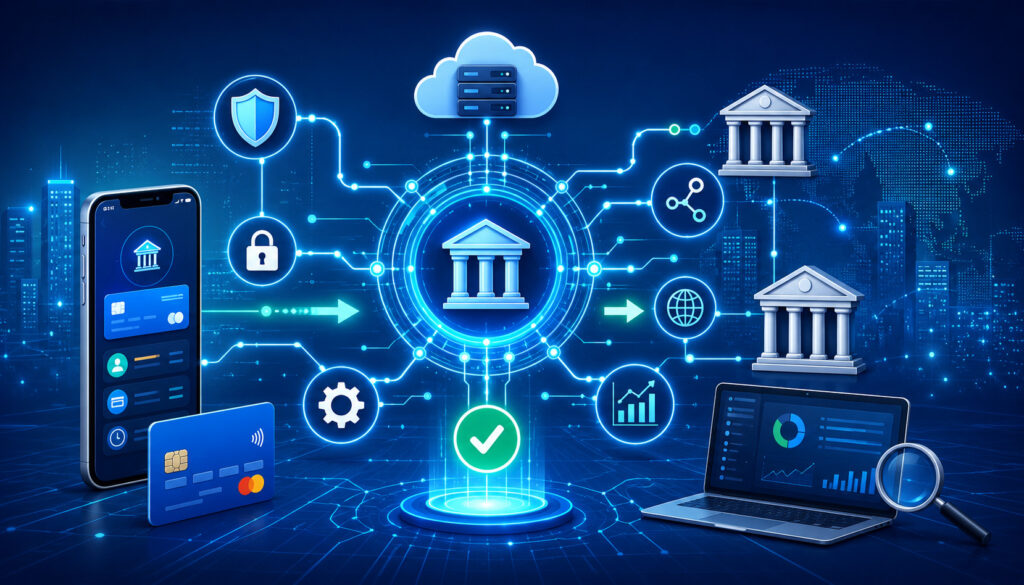
Banking payment APIs may include many features, but certain capabilities matter across most use cases. These include secure authentication, payment initiation, account validation, status tracking, webhooks, reporting, error responses, transaction limits, compliance screening, sandbox testing, developer documentation, and uptime monitoring.
Secure authentication confirms that only approved systems can connect. Authorization controls what those systems are allowed to do. For example, one application may be allowed to check status but not initiate payments. Another may create payment drafts but require human approval before release.
Payment initiation APIs create payment requests. Account validation features help check recipient or account details before payment. Status APIs show what is happening after submission. Webhooks notify systems when payment events occur.
Reporting APIs support reconciliation and accounting. Error responses help software teams and finance teams understand why a payment failed. Transaction limits reduce exposure. Compliance screening may help identify unusual or restricted activity.
Sandbox testing allows developers to test integrations before real money moves. Documentation explains endpoints, fields, authentication, response codes, rate limits, examples, and webhook behavior.
API security is a major consideration because APIs expose business logic and sensitive data. Recognized API security guidance emphasizes risks such as weak authorization, broken authentication, excessive data exposure, and other API-specific vulnerabilities.
Secure Authentication
Secure authentication verifies that the system trying to access the API is legitimate. Banking payment APIs may rely on API keys, OAuth, tokens, certificates, signed requests, IP allowlisting, mutual authentication, or other approved controls.
Authentication should not be treated as a one-time setup. Credentials must be stored securely, rotated when needed, monitored for unusual use, and limited to the minimum required permissions. Secrets should not be stored in code repositories, shared spreadsheets, or unsecured chat messages.
Authorization is related but different. Authentication asks, “Who or what is connecting?” Authorization asks, “What is this user or system allowed to do?” A well-designed API should separate these controls.
Strong authentication is especially important for instant banking APIs because payments may move quickly once approved. A compromised credential can become a serious risk if it allows payment initiation or recipient changes.
Account and Recipient Validation
Account and recipient validation helps reduce failed payments, misdirected transfers, and fraud risk. Before sending funds, a business should confirm that recipient details are accurate and that the payment destination matches the intended payee.
Validation can include checking account format, routing details, account status, recipient identity, or beneficiary information where supported. The available validation methods depend on the payment system, jurisdiction, provider, and account type.
Recipient validation is especially important for new vendors, changed bank details, customer refunds, payroll updates, contractor payouts, and high-value payments. Many payment fraud schemes rely on redirecting funds to an account controlled by a criminal.
Validation does not eliminate risk, but it creates a stronger “verify before sending” workflow. It is one of the most practical controls for real-time payment systems.
Error Handling
Error handling determines how systems respond when something goes wrong. In payment API integration, errors may happen because of invalid fields, insufficient permissions, expired credentials, duplicate requests, unsupported currencies, account validation failure, transaction limits, compliance review, timeout issues, or receiving institution rejection.
Clear error codes help developers build reliable systems. Clear error messages help finance teams understand the business action needed. For example, a missing payment reference requires a different response than a suspected duplicate payment.
A strong integration should map technical errors into operational actions. Some errors may require retrying. Some require user correction. Some require compliance review. Some should block the payment completely.
Poor error handling can create duplicate payments, unresolved exceptions, customer confusion, and reconciliation problems.
Sandbox Testing
Sandbox testing allows teams to test API behavior before live payment activity begins. A sandbox may provide test credentials, sample endpoints, mock payment responses, fake status updates, webhook events, and simulated failure scenarios.
Testing should cover both successful and unsuccessful cases. Teams should test authentication, payment creation, recipient validation, duplicate prevention, status checks, webhooks, timeouts, failed payments, refunds, reporting exports, user permissions, and reconciliation.
Sandbox testing also helps finance and operations teams understand how the system behaves. They can review approval workflows, exception queues, reporting fields, and reconciliation outputs before launch.
A sandbox is valuable only if it reflects real behavior closely enough. Teams should ask what is simulated, what is not supported, and what differences exist between test and production environments.
Instant Payment API Feature Checklist
| Feature | What it does | Why it matters | Question to ask | Best practice |
| Authentication | Verifies approved API access. | Protects sensitive payment functions. | What methods are supported? | Use strong credentials, rotation, and secure storage. |
| Authorization | Controls permitted actions. | Limits misuse and reduces exposure. | Can permissions be scoped by role or endpoint? | Apply least-privilege access. |
| Payment initiation | Creates payment requests. | Starts money movement from approved systems. | What fields are required? | Validate all data before submission. |
| Status tracking | Shows payment progress. | Reduces uncertainty and support work. | What statuses and reason codes are available? | Store full status history. |
| Webhooks | Sends payment event notifications. | Enables event-driven automation. | Are events signed and retryable? | Verify signatures and handle duplicates. |
| Account validation | Checks recipient or account details. | Reduces failed or misdirected payments. | What validation level is available? | Verify new and changed recipients. |
| Transaction limits | Restricts payment size or volume. | Reduces risk exposure. | Can limits vary by user or use case? | Set limits by role, amount, and risk. |
| Reporting | Provides transaction records. | Supports finance and treasury visibility. | What fields are included? | Use consistent references. |
| Reconciliation | Helps match payments to records. | Reduces manual accounting work. | Can reports connect to ERP or accounting tools? | Map references before launch. |
| Error handling | Explains failed requests. | Helps teams resolve issues quickly. | Are error codes documented? | Map errors to business actions. |
| Sandbox access | Enables pre-launch testing. | Reduces production surprises. | Does it simulate failures and webhooks? | Test success, failure, retry, and timeout scenarios. |
| Documentation | Explains endpoint behavior. | Helps developers build safely. | Are examples and edge cases included? | Review docs with engineering and finance teams. |
| Uptime monitoring | Tracks availability and performance. | Supports operational resilience. | Is there a status page or alert process? | Monitor latency, errors, and downtime. |
Payment API Integration in Banking Systems
Payment API integration in banking systems involves more than connecting code to an endpoint. It requires business planning, technical design, security setup, compliance review, fraud controls, user permissions, reconciliation mapping, operational testing, and production support.
The first step is understanding the payment use case. A payroll integration has different needs from a marketplace payout workflow. A treasury transfer has different controls from a customer refund process. A B2B vendor payment may require invoice references, approval records, and remittance data.
Next, teams must review API documentation. Documentation should explain authentication, endpoints, required fields, optional fields, status codes, error codes, webhook behavior, rate limits, idempotency, testing tools, and production launch steps.
Security setup is critical. This includes credential management, OAuth flows or token handling, API keys, certificates, role-based permissions, IP allowlisting, audit logs, secrets management, and monitoring.
Compliance and fraud controls should be reviewed before launch. Payment APIs may support fast money movement, so recipient verification, approval workflows, transaction limits, screening, and exception review should be designed into the process.
Finally, reconciliation must be planned early. Payment references, invoice numbers, settlement IDs, fee fields, currency fields, and timestamps should be mapped before live payments begin.
Define the Payment Use Case
A strong payment API integration starts with a clear use case. Teams should define whether the API will support payroll, vendor payments, customer refunds, marketplace payouts, treasury transfers, B2B payments, subscription billing, or financial platform workflows.
Each use case has different requirements. Payroll may require employee or contractor records, approval deadlines, tax-related documentation handled outside the API, and strict access controls. Vendor payments may require invoice numbers, purchase order references, and dual approval. Customer refunds may require links to original transactions and fraud review.
Defining the use case also helps determine payment limits, required data fields, exception handling, and reporting needs. A low-value recurring payout workflow may have different controls from a high-value treasury transfer.
Without a clear use case, teams may overbuild, under-secure, or miss important reconciliation data.
Map Data Fields
Payment instructions require accurate data. Data fields may include recipient name, account details, routing information, amount, currency, reference number, invoice number, payment purpose, sender information, recipient address, and approval metadata.
Field mapping connects business systems to payment APIs. For example, an invoice ID in an ERP system may need to map to a payment reference field. A supplier record may need to map to beneficiary information. A currency field may need to map to both sender currency and recipient currency for cross-border payment APIs.
Bad field mapping creates problems. Payments may fail, reconciliation may break, and finance teams may need to investigate unmatched records. Missing references can make it difficult to connect a payment to an invoice.
Teams should document required fields, optional fields, validation rules, formatting rules, character limits, and fallback behavior.
Test Before Going Live
Testing before launch is essential. Payment API integration should be tested for successful payments, failed payments, duplicate attempts, timeouts, expired credentials, invalid fields, rejected payments, webhook retries, status mismatches, reporting exports, and reconciliation.
Testing should involve more than developers. Finance teams should review reports. Operations teams should review exception workflows. Security teams should review credential handling. Compliance or risk teams should review controls.
A good test plan should include realistic scenarios. For example, what happens if a payment is submitted twice? What happens if a webhook arrives before the system checks status? What happens if a payment is accepted but later rejected? What happens if a user loses permission after creating but before approving a payment?
Testing should also include operational readiness. Teams need clear instructions for monitoring, incident response, support escalation, and payment exception handling.
Instant Payment APIs and Settlement
Instant payment APIs interact with clearing and settlement processes, but they do not control every part of settlement. APIs may initiate payments, provide status updates, and return settlement references, but actual settlement depends on the payment rail, participating institutions, rules, liquidity, compliance review, receiving institution processes, and transaction eligibility.
This distinction is important. A payment request may be accepted by an API, but that does not always mean funds are finally settled. Depending on the system and payment type, there may be additional steps before funds are available or final.
Instant payment systems are designed to support faster clearing and settlement than many traditional payment methods. Official descriptions of certain instant payment infrastructure explain that it can provide interbank clearing and settlement that transfers funds between sender and receiver accounts in near real time and on a continuous basis.
For businesses, settlement visibility matters because accounting and treasury decisions depend on reliable records. A payment that is initiated but not final should not be treated the same as a completed settlement.
APIs can help by providing settlement status, timestamps, payment IDs, rail references, return codes, and reconciliation data. These fields help finance teams understand whether a payment is pending, completed, rejected, returned, or settled.
Payment Confirmation vs Final Settlement
Payment confirmation and final settlement are related but not always the same. A payment confirmation may mean the request was received, validated, accepted for processing, or completed. Final settlement means the funds movement has reached the point defined by the payment system rules as final or complete.
Businesses must understand what each status means. “Accepted” may not mean the same thing as “settled.” “Processing” may not mean funds are available. “Completed” may have a specific definition in the API documentation.
Misunderstanding status labels can create problems. A business may release goods, mark an invoice paid, or update a customer balance too early if it treats every confirmation as final settlement.
Teams should review payment documentation and define internal rules for when a payment is considered complete.
Settlement Finality
Settlement finality means a completed payment is not expected to be unwound through normal processing. This matters for instant payments because speed can reduce the time available to correct errors or stop fraud.
When payment finality applies, prevention becomes more important than recovery. Businesses should verify recipients, validate account details, review unusual payments, and apply approval workflows before sending funds.
Finality also affects customer communication. If a payment cannot be easily reversed, users should understand the importance of confirming recipient details and payment amounts before approval.
For finance teams, finality supports certainty. Once settlement is final, records can be closed with more confidence. However, the team must know which API status represents finality.
Settlement Reporting
Settlement reporting provides the records finance teams need to close the payment loop. Useful settlement reports include payment IDs, references, settlement timestamps, amount, currency, fees, recipient details, status, return information, and related invoice or payout IDs.
APIs can deliver settlement reporting through direct endpoints, downloadable reports, webhooks, or scheduled exports. The key is consistency. The same reference used when creating a payment should appear in settlement reporting.
Settlement reporting supports reconciliation, cash positioning, audit review, customer support, and financial close. Without clean settlement data, faster payments may create faster confusion.
Instant Payment APIs and ISO 20022
ISO 20022 is a financial messaging standard that supports structured payment data. It gives financial systems a common way to describe payment messages, business processes, and data elements. Official standards information describes ISO 20022 as a common platform for financial message development.
For instant payment APIs, ISO 20022 matters because richer payment data can support better interoperability, compliance screening, reporting, and reconciliation. Instead of sending limited or unstructured payment information, systems can exchange more consistent details.
Structured data may include party information, payment purpose, remittance information, invoice references, account identifiers, transaction IDs, and status messages. This helps banks, payment systems, businesses, and software platforms understand payment context more clearly.
ISO 20022 can also support global banking API interoperability. When systems use more consistent message structures, it becomes easier to map data across institutions, payment rails, treasury tools, and reporting systems.
However, ISO 20022 does not automatically solve every integration problem. Businesses still need accurate data entry, field mapping, validation, documentation, and reconciliation processes. A rich message format is only useful when the data inside it is correct and consistently used.
For more background, readers can review this internal guide on the role of ISO 20022 in payment infrastructure modernization.
Richer Payment Data
Richer payment data means a payment message can carry more structured information. This may include invoice details, payment purpose, sender and receiver information, structured references, and remittance notes.
For businesses, richer data reduces confusion. A vendor can see which invoice was paid. A finance team can match the payment to a customer account. A treasury system can identify payment purpose and timing.
Richer data also helps reduce manual investigation. When payment records include useful references and consistent fields, accounting teams spend less time asking, “What is this payment for?”
APIs that support structured payment data should explain which fields are required, which are optional, and how they appear in status and settlement reports.
Better Reconciliation
Finance teams benefit when payment data is consistent from initiation through settlement. If an invoice number is included in the original payment request and appears again in the settlement report, reconciliation becomes easier.
Better reconciliation reduces manual matching, improves close processes, and helps teams identify exceptions faster. It also supports audit trails because the business can show how a payment moved through approval, initiation, status updates, settlement, and accounting records.
Instant payment APIs can support better reconciliation when they preserve references across the payment lifecycle. The challenge is discipline. Teams must decide which references to use and ensure all systems follow the same structure.
A strong reconciliation design should include unique payment IDs, invoice references, customer IDs, vendor IDs, settlement IDs, timestamps, fees, and status history.
Cross-Border Payment Support
Cross-border payment APIs often need richer data because international payments involve more variables. These may include sender currency, recipient currency, FX conversion, beneficiary information, payment purpose, compliance screening, local routing details, and settlement timing.
Structured messaging can help financial institutions and payment systems exchange more useful information. This can reduce ambiguity and support better screening, reporting, and reconciliation.
However, cross-border instant payment capability varies. A payment may be fast in one corridor but slower in another. Availability depends on participating institutions, currencies, local rules, payment rails, compliance checks, and settlement arrangements.
Businesses should evaluate cross-border payment APIs carefully and avoid assuming that every international payment can be instant.
Instant Payment APIs in Cross-Border Banking
Instant payment APIs can support cross-border banking workflows by connecting systems that handle payment initiation, routing, currency information, compliance screening, beneficiary validation, status tracking, and settlement reporting.
These APIs are important for businesses that pay international suppliers, support marketplace sellers, manage global payroll, process refunds, or operate multi-currency treasury workflows.
Cross-border payment APIs may require additional data compared with domestic payments. The payment request may need sender currency, recipient currency, exchange rate, conversion fee, amount received, beneficiary address, payment purpose, and local account details.
Cross-border payments also involve more compliance checks. AML, KYC, sanctions screening, transaction monitoring, and recordkeeping can affect whether a payment is approved, delayed, rejected, or reviewed. Businesses should understand that faster API communication does not remove these controls.
Status tracking becomes especially important in cross-border workflows. A payment may move through multiple institutions or systems. The sender may need to know whether the payment is accepted, routed, under review, converted, settled, or returned.
Global payment APIs can improve visibility, but they cannot guarantee identical speed everywhere. Capability varies by corridor, bank, currency, payment rail, liquidity, local rules, and receiving institution processes.
Multi-Currency Payment Data
Multi-currency payment data helps businesses understand how much is sent, how much is converted, and how much the recipient is expected to receive. A cross-border API may include sender currency, recipient currency, FX rate, conversion fee, transfer fee, and final amount.
This information matters for customer communication, vendor agreements, payroll records, and reconciliation. If a supplier expects a specific amount in their local currency, the business must understand how conversion affects the payment.
Multi-currency data should be stored carefully. Exchange rates may change, fees may vary, and settlement amounts may differ from the original estimate depending on the payment setup.
Businesses should ask whether the API provides quote IDs, rate expiration details, fee breakdowns, and final settlement amounts.
Cross-Border Compliance Checks
Cross-border compliance checks help payment systems identify restricted parties, unusual activity, incomplete sender or recipient information, and transactions that may require review. These checks can include KYC, AML, sanctions screening, and transaction monitoring.
For businesses, compliance checks may appear as payment holds, additional information requests, rejections, or delayed status updates. This does not always mean something is wrong. It may mean the payment needs review before processing.
The key is preparation. Businesses should collect accurate recipient data, document payment purpose, maintain invoice records, and respond quickly to information requests.
Because compliance obligations vary by payment type and jurisdiction, businesses should treat this section as educational and consult qualified professionals when needed.
Global Payment Status Tracking
Global payment status tracking helps businesses understand where a payment stands. This is important because international payments may involve multiple steps, including initiation, validation, routing, screening, FX conversion, settlement, and recipient confirmation.
A useful status API should provide clear status labels, timestamps, payment references, reason codes, return information, and fee details where available. It should also explain what each status means.
Without clear tracking, businesses may struggle to answer vendor or customer questions. They may also mark invoices paid too early or fail to notice a returned payment.
Global payment status tracking is strongest when connected to reconciliation. Status data should flow into ERP, accounting, treasury, and reporting systems.
Security Requirements for Instant Banking APIs
Security is critical for instant banking APIs because they connect systems that can initiate or track money movement. A weak API setup can expose sensitive payment data, allow unauthorized access, or create fraud risk.
Security should include authentication, authorization, encryption, tokenization, API permissions, rate limits, monitoring, IP allowlisting, audit logs, key rotation, secrets management, and incident response.
APIs should use secure credentials and avoid long-lived secrets stored in unsafe locations. Access should be limited by role, function, environment, and business need. A system that only needs reporting access should not have payment initiation permissions.
Encryption helps protect sensitive data in transit and at rest where applicable. Tokenization can reduce exposure by replacing sensitive values with limited-use tokens. Audit logs help teams investigate who accessed an API, what action was taken, when it happened, and from where.
Rate limits and monitoring help protect availability and detect unusual activity. If a credential is abused, the system should be able to detect spikes, repeated failures, suspicious endpoints, or unusual payment patterns.
API security should align with recognized best practices for access control, authentication, authorization, monitoring, and secure design. Public API security guidance highlights that APIs often expose sensitive data and business logic, making them attractive targets.
Authentication and Authorization
Authentication verifies access. Authorization controls permitted actions. Both are necessary for secure instant payment API integration.
For example, an API client may authenticate successfully with a valid token. But that does not mean it should be authorized to create payments, approve payments, add recipients, increase limits, or view sensitive reports.
Good authorization uses scopes, roles, permissions, and approval rules. A reporting tool may only need read access. A payroll system may need payment creation access but not administrative access. A treasury administrator may need broader permissions but should still require strong approval controls.
Businesses should review permissions regularly. Users and systems often accumulate access over time. Old credentials, unused accounts, and excessive permissions create avoidable risk.
Encryption and Data Protection
Encryption protects payment data as it moves between systems and when it is stored where applicable. Sensitive information may include account details, payment references, authentication credentials, personal information, transaction data, and reconciliation records.
Encryption should be paired with strong key management. If keys are mishandled, encryption loses value. Businesses should protect keys, rotate them when needed, limit access, and monitor usage.
Data protection also includes minimizing what is stored. If a system does not need full account details after tokenization, it should avoid storing them. If logs are needed for troubleshooting, they should not expose secrets or sensitive payment data.
Strong data protection supports cybersecurity, privacy, compliance, and customer trust.
API Monitoring and Rate Limits
API monitoring tracks activity, performance, errors, and unusual behavior. Rate limits control how many requests can be made within a defined period. Together, they help protect system availability and reduce abuse.
Monitoring should include authentication failures, payment creation attempts, status check volume, webhook delivery failures, error rates, latency, and unusual transaction patterns.
Rate limits can help prevent credential abuse, accidental traffic spikes, and denial-of-service style pressure. However, limits must be designed carefully. Too strict, and legitimate payment workflows may fail. Too loose, and abuse may be harder to contain.
Businesses should understand rate limit rules before launch and design retry logic that does not overwhelm the API.
Fraud Prevention in Real-Time Payment APIs
Faster payments create new fraud prevention needs because there may be less time to detect and stop suspicious activity. Real-time payment APIs should be paired with controls that verify users, validate recipients, monitor transactions, and require stronger approval for unusual activity.
Common risks include account takeover, fake invoices, payment redirection, mule accounts, business email compromise, unusual transaction patterns, and social engineering. These risks are not unique to instant payments, but speed can increase their impact.
Fraud prevention should begin before payment initiation. Systems should verify users, protect credentials, review new recipients, and apply limits. During payment creation, systems should check transaction patterns, payment amount, recipient history, device signals, and approval records.
After payment initiation, monitoring should continue. Alerts, exception queues, audit logs, and reconciliation reviews can help identify issues. However, post-transaction review is not enough for payments that may settle quickly.
Internal teams can also review instant payment security best practices to strengthen fraud controls around fast payment workflows.
Account Takeover Risk
Account takeover occurs when an attacker gains access to a legitimate user account or system credential. The attacker may use that access to add recipients, change payment details, initiate payments, approve transfers, or view sensitive data.
Instant payment APIs can increase the impact of account takeover because payment actions may happen quickly. If an attacker obtains an API key or token with broad permissions, they may be able to create payment requests at scale.
Controls should include strong authentication, secure credential storage, MFA for user access, device monitoring, IP restrictions, token expiration, key rotation, and anomaly detection.
Sensitive actions should require additional checks. Adding a new recipient, changing bank details, increasing limits, and initiating high-value payments should not rely only on basic login access.
Payee Verification
Payee verification helps confirm that the payment destination matches the intended recipient. This is one of the most important fraud and error controls for instant payments.
Fraudsters often try to redirect payments by changing invoice details, impersonating vendors, or compromising email accounts. If a business sends funds to the wrong account, recovery may be difficult.
Payee verification can include validating account details, confirming recipient identity, reviewing vendor records, checking account ownership where supported, and verifying changes through a trusted contact channel.
Businesses should apply stronger verification for first-time recipients, changed account details, unusual payment requests, customer refunds, and high-value payments.
Approval Workflows
Approval workflows help prevent unauthorized or mistaken payments. A strong workflow separates payment creation from payment approval. It also applies higher review standards to higher-risk transactions.
For example, routine low-value payments to known recipients may follow a standard process. High-value payments, new recipients, changed account details, unusual timing, or urgent requests may require dual approval or exception review.
Approval workflows should be built into systems, not handled informally through chat or email. The approval record should show who approved the payment, when they approved it, and what information they reviewed.
Good workflows reduce fraud risk without blocking normal operations unnecessarily.
Compliance Considerations for Payment APIs
Compliance considerations for payment APIs include KYC, AML, sanctions screening, recordkeeping, audit trails, transaction monitoring, data privacy, consumer protection, and supervisory expectations. This article is informational only and does not provide legal, tax, investment, or financial advice.
Payment systems need to understand who is sending money, who is receiving money, why money is moving, and whether activity appears unusual or restricted. APIs can help collect and transmit data, but compliance responsibility depends on the payment model, institution, provider, rules, and applicable obligations.
Businesses should expect payment API workflows to include onboarding, identity verification, account verification, transaction limits, risk review, and reporting. Some payments may be delayed or rejected if data is missing, a recipient cannot be validated, or screening flags the transaction.
Recordkeeping is also important. Payment records should include initiation details, approval logs, recipient information, status history, settlement references, return reasons, and reconciliation data.
Compliance controls should be reviewed before launch, especially for cross-border payment APIs, marketplace payouts, payroll, refunds, and high-volume B2B transfers.
KYC and Identity Checks
KYC means payment systems need to understand who is using the service. Identity checks may apply to businesses, beneficial owners, account users, recipients, or platform participants depending on the payment model.
For businesses, this may require collecting legal business information, tax-related records handled outside the API, ownership details, authorized user information, and bank account details. For recipients, the required information may vary by use case and payment type.
KYC helps reduce misuse of payment systems. It also supports fraud prevention and transaction monitoring.
Businesses should plan onboarding workflows carefully. Missing or inconsistent identity data can delay payment setup, create compliance review, or prevent certain payment flows from being enabled.
AML and Transaction Monitoring
AML and transaction monitoring help identify suspicious patterns. A payment system may review transaction size, frequency, recipient behavior, geographic patterns, account history, payment purpose, and unusual changes.
In API-based payments, monitoring should happen close to real time where possible. Fast payments require risk checks that can identify suspicious activity before funds move or before additional payments are sent.
Businesses should understand how exceptions are handled. A payment may be held for review, rejected, or require more information. Internal teams should know who responds to these requests and what documentation is needed.
Transaction monitoring should not be viewed as a one-time setup. Risk patterns change, and monitoring rules may need periodic review.
Sanctions Screening
Sanctions screening checks payment parties and related information against restricted parties, entities, or jurisdictions. This can affect domestic and cross-border payments depending on the payment model and regulatory expectations.
Screening may review sender information, recipient information, business names, addresses, countries, and other transaction details. If a potential match appears, the payment may be paused for review.
Businesses should keep payment data accurate. Incomplete names, abbreviations, missing addresses, or inconsistent records can create false positives or delays.
Because sanctions screening can be complex, organizations should rely on qualified compliance guidance for specific obligations.
Global Banking API Risk Table
| Risk | How it appears | Business impact | Control to consider | Documentation to keep |
| Fraud | Fake invoices, account takeover, payment redirection. | Financial loss, disputes, operational disruption. | Payee verification, MFA, transaction monitoring, approval workflows. | Approval logs, recipient verification records, fraud alerts. |
| Duplicate payments | Retry logic submits the same payment twice. | Overpayment, reconciliation issues, vendor confusion. | Idempotency keys, unique references, duplicate checks. | Payment IDs, request logs, retry records. |
| Failed payments | Invalid fields, recipient issues, limit problems. | Delayed payroll, vendor disputes, customer complaints. | Pre-validation, clear error handling, exception queues. | Error codes, status history, correction notes. |
| API downtime | Endpoint unavailable or slow. | Payment delays, poor user experience, manual fallback. | Monitoring, failover planning, support process. | Incident reports, downtime logs, communication records. |
| Weak authentication | Exposed keys or broad access. | Unauthorized payment activity. | Secure secrets management, key rotation, scoped permissions. | Access logs, permission reviews, credential rotation history. |
| Poor reconciliation | Missing references or inconsistent reports. | Manual work, accounting errors, delayed close. | Standard payment references, settlement mapping. | Reconciliation exports, unmatched item reports. |
| Compliance holds | Payment flagged for review. | Delays, additional information requests. | Complete data, screening workflows, escalation process. | KYC records, review notes, supporting invoices. |
| Data mismatch | ERP fields do not match API requirements. | Rejections, wrong postings, reporting gaps. | Field mapping, validation rules, test cases. | Data mapping documents, test results. |
| Settlement delays | Payment accepted but not finalized as expected. | Cash flow uncertainty, support inquiries. | Status tracking, settlement reporting, clear internal rules. | Settlement IDs, timestamps, status definitions. |
Instant Payment APIs for Business Use Cases
Instant payment APIs can support a wide range of business use cases. The common theme is controlled automation: payment instructions move from business systems into approved payment workflows, and status information returns to the systems that need it.
For payroll teams, APIs can support faster wage, contractor, or gig payments. For vendor teams, they can connect invoice approvals with payment initiation.
For B2B users, they can link ERP tools, account-to-account payment APIs, and settlement reporting. For marketplaces, they can automate seller payouts and exceptions. For customer service teams, APIs can support faster refunds with better tracking.
Treasury teams may use APIs for cash positioning, liquidity visibility, internal transfers, and payment status. Subscription businesses may use APIs to manage recurring payments, payment retries, customer notifications, and failed payment tracking.
Each use case requires different controls. A customer refund workflow may need fraud review. A payroll workflow may need strict approval deadlines. A marketplace payout workflow may need recipient onboarding, balance checks, seller verification, and exception handling.
The value of instant payment APIs is not only speed. It is also the ability to connect payment activity with the business records that explain why the payment exists.
Payroll and Contractor Payments
Payroll and contractor payment workflows can use instant payment APIs to send approved wage, contractor, or gig payments more quickly where supported. This can be useful for off-cycle payments, urgent corrections, contractor payouts, and flexible work arrangements.
However, payroll payments require strong controls. The system should validate recipients, protect employee or contractor data, require approval, and maintain complete records. Changes to payment details should receive extra verification.
Payment status visibility is important. Payroll teams need to know whether payments were accepted, rejected, completed, or returned. Workers may also need clear communication about payment timing and status.
APIs can improve payroll operations, but they should be integrated with payroll records, approval workflows, and reconciliation reporting.
Vendor and Supplier Payments
Vendor and supplier payments often involve invoices, purchase orders, approvals, due dates, and remittance information. Instant payment APIs can help connect these records to payment initiation and status tracking.
For example, after an invoice is approved, an ERP system may create a payment request through an API. The API response can update the invoice record. A settlement report can later confirm completion.
Vendor payments require payee verification. Fraudsters often target vendor payment workflows by sending fake invoices or changed account instructions. Businesses should verify new vendors and changed bank details through trusted channels.
A strong vendor payment API setup should include invoice references, approval logs, payment status, exception handling, and reconciliation fields.
B2B Payments
B2B payments can benefit from API-based payments because they often involve complex records. A payment may need to match invoices, purchase orders, customer accounts, delivery records, and contract terms.
Real-time banking APIs can help businesses initiate account-to-account payments, track payment status, and reconcile records across ERP and accounting systems. This improves visibility for both buyers and suppliers.
B2B payment workflows should include clear references. If a payment covers multiple invoices, the remittance data should explain what is being paid. This reduces back-and-forth between accounts receivable and accounts payable teams.
API-based B2B payments work best when business data and payment data are connected from the start.
Marketplace Payouts
Marketplaces may use instant payment APIs to automate seller, creator, driver, or service-provider payouts. APIs can help calculate payout amounts, initiate payments, track status, and handle exceptions.
Marketplace payouts require careful onboarding. The platform should validate sellers, collect required information, verify payout accounts, apply limits, and monitor unusual activity.
Status tracking is important because sellers often ask when they will be paid. A payout dashboard can use API data to show whether funds are pending, processing, completed, or under review.
Marketplaces should also plan for failed payouts, account changes, refunds, reversals handled by platform rules, and reconciliation between seller balances and payment records.
Customer Refunds
Customer refunds can be improved with instant payment APIs when faster refund options are supported. A refund workflow may begin in a customer service system, pass through fraud review, and then initiate a payment through an API.
Refunds need strong controls because fraudsters may attempt to exploit refund processes. Businesses should verify refund eligibility, connect refunds to original transactions, and review unusual patterns.
Status APIs help customer support teams answer questions. Instead of telling customers to wait without details, teams can see whether a refund is pending, sent, rejected, or completed.
Refund reconciliation should connect the refund payment to the original customer record, order number, and settlement data.
Treasury Operations
Treasury teams need visibility into cash positions, payment timing, liquidity, and settlement. Instant payment APIs can help treasury systems initiate transfers, monitor payment status, and update cash forecasts.
APIs can also support internal reporting. Treasury teams may use payment status, settlement timestamps, and transaction references to understand cash movement more accurately.
Operational controls are especially important for treasury payments because amounts may be large. Dual approval, transaction limits, role-based access, and audit logs should be part of the workflow.
Treasury teams should also plan for API downtime, delayed confirmations, and exception handling.
Subscription and Recurring Payments
Subscription and recurring payment workflows can use APIs to initiate payments, retry failed payments, update customer records, send notifications, and reconcile recurring billing activity.
The system should handle payment failures carefully. A failed payment may require customer notification, retry scheduling, account update, or service status change.
Recurring payment workflows need clear authorization records. Businesses should document customer consent, payment terms, retry rules, and cancellation processes where applicable.
APIs can make recurring payment operations more automated, but teams must avoid uncontrolled retries, duplicate billing, and unclear customer communication.
Instant Payment APIs for Different Financial Institutions
Different financial institutions and payment organizations use instant payment APIs in different ways. Banks, credit unions, payment processors, fintech platforms, treasury providers, and embedded finance platforms may all need APIs, but their requirements vary.
A financial institution may use APIs to connect core account systems, payment rails, customer interfaces, fraud tools, compliance screening, reporting systems, and digital banking applications. A payment processor may use APIs to route payment requests, return status updates, support settlement reporting, and provide reconciliation data.
A treasury provider may focus on cash visibility, payment approval, liquidity reporting, and ERP integration. An embedded finance platform may use APIs to place payment capabilities inside business software.
Businesses using these APIs should understand their role in the chain. Some organizations connect directly to payment systems. Others connect through approved providers. The provider’s documentation should explain supported payment rails, account types, limits, settlement behavior, and reporting fields.
No matter the institution type, the core API needs are similar: secure access, clear documentation, reliable status tracking, strong controls, and clean reconciliation.
Banks and Credit Unions
Banks and credit unions may use APIs to connect account systems, payment rails, digital banking channels, fraud systems, compliance tools, and reporting engines. APIs can help them offer payment initiation, status tracking, alerts, and account-to-account payment services.
Financial institutions must balance customer experience with risk controls. Instant payments can improve service, but they also require strong authentication, recipient verification, transaction monitoring, liquidity planning, and operational readiness.
APIs may also help institutions support business customers. A business may want to connect treasury systems or ERP tools directly to banking payment APIs. That requires documentation, permissions, sandbox testing, and support.
Institutions should also plan for continuous operations because instant payment systems may run outside traditional business hours.
Payment Processors and Platforms
Payment processors and platforms may use APIs to offer payment initiation, routing, status tracking, settlement reporting, reconciliation, and exception management. They may act as a connection layer between businesses and multiple payment rails.
Processors and platforms often need flexible APIs because their customers may include marketplaces, software platforms, merchants, payroll teams, and B2B users. Each use case may require different fields, controls, and reporting.
A strong platform API should provide clear documentation, sandbox testing, webhook support, error codes, idempotency, reporting exports, and operational support.
Businesses should review whether the platform supports the payment flows, currencies, limits, and settlement reporting they need.
Businesses and Treasury Teams
Businesses and treasury teams may use instant payment APIs through approved providers or banking relationships. Their goal is often to automate payment workflows, improve visibility, and reduce manual reconciliation.
Treasury teams should involve finance, technology, security, and operations before launch. They need to define use cases, approval workflows, payment limits, user permissions, reporting requirements, and incident response procedures.
Businesses should also train users. A payment API may be technical, but payment decisions are operational. Employees need to understand recipient verification, approval rules, exception handling, and fraud red flags.
The best integrations support both automation and control.
Developer and Operations Challenges
Instant payment API integration can be powerful, but it also creates technical and operational challenges. Common issues include documentation gaps, inconsistent data formats, authentication complexity, webhook reliability, timeout handling, duplicate payment prevention, sandbox limitations, error code mapping, monitoring gaps, and reconciliation issues.
Developers need clear documentation and predictable API behavior. Finance teams need reliable reporting and understandable statuses. Operations teams need exception workflows. Security teams need credential control and monitoring.
One common challenge is duplicate payment prevention. If a request times out, the software may not know whether the payment was created. Retrying without safeguards can create duplicate payments. Idempotency keys and unique payment references help reduce this risk.
Webhook reliability is another challenge. Webhooks may be delayed, repeated, missed, or delivered out of order. Systems should store events, verify signatures, handle retries, and query payment status when needed.
Error code mapping is also important. A technical error should translate into a business action. For example, “invalid recipient field” should trigger data correction, while “payment under review” should trigger an exception workflow.
Duplicate Payment Prevention
Duplicate payments can happen when retry logic is poorly designed. For example, a system sends a payment request but does not receive a response because of a timeout. If the system sends the same request again without a unique idempotency key or duplicate check, the payment may be created twice.
Duplicate prevention should be built into both technical and business processes. APIs should support unique request IDs where available. Internal systems should generate unique payment references. Finance teams should review duplicate warnings before release.
Retries should be controlled. Not every error should trigger an automatic retry. Some errors require status checks first. Some require user correction. Some should block further action.
Duplicate prevention protects cash flow, vendor relationships, customer trust, and reconciliation accuracy.
Webhook Reliability
Webhooks are useful, but they are not perfect. A webhook can fail because the receiving endpoint is down, the network is slow, the message is delayed, or the event arrives more than once.
Systems should treat webhooks as important event notifications, not as the only source of truth. Each webhook should include an event ID, timestamp, payment ID, status, and signature. The receiving system should verify the signature, store the event, and ignore duplicates.
Out-of-order events are also possible. A system may receive a “completed” event before a delayed “processing” event. The integration should understand status sequence rules and avoid moving a payment backward incorrectly.
A status API can help confirm the current state when webhook events are unclear.
Error Code Mapping
Error code mapping turns technical responses into useful business actions. Developers may understand HTTP codes and API errors, but finance teams need to know what to do.
For example, an authentication error may require credential review. A validation error may require correcting recipient data. A limit error may require approval or payment splitting if allowed. A compliance review status may require waiting or submitting more information.
Good documentation should explain each error code, likely cause, retry behavior, and recommended action. Internal systems should display clear messages to authorized users without exposing sensitive technical details.
Error mapping reduces support tickets, prevents repeated failed attempts, and improves operational confidence.
Payment API Testing Checklist
| Test area | What to test | Why it matters | Failure scenario | Best practice |
| Authentication | Valid, expired, revoked, and incorrect credentials. | Protects API access. | Expired token blocks payment creation. | Test credential rotation and failure alerts. |
| Payment creation | Required fields, optional fields, valid amounts. | Ensures payment requests are formed correctly. | Missing recipient field causes rejection. | Validate before submission. |
| Duplicate prevention | Idempotency keys and unique references. | Prevents accidental double payments. | Timeout causes repeated submission. | Check status before retrying. |
| Status checks | Pending, accepted, rejected, settled, returned. | Supports accurate operations. | Team marks payment complete too early. | Define status meanings internally. |
| Webhooks | Signed events, retries, duplicates, out-of-order events. | Keeps systems updated. | Event is missed during downtime. | Store events and verify through status API. |
| Failed payments | Invalid account, limit issue, rejected request. | Prepares exception workflows. | Finance team does not know next step. | Map errors to business actions. |
| Timeouts | Slow response or no response. | Prevents duplicate attempts. | System retries without checking status. | Use safe retry logic. |
| Refunds | Approved, rejected, and duplicate refund attempts. | Protects customer workflows. | Refund sent twice. | Link refunds to original records. |
| Reconciliation exports | Settlement IDs, fees, timestamps, references. | Supports accounting close. | Missing invoice reference. | Test end-to-end matching. |
| Access permissions | User roles and system scopes. | Reduces unauthorized actions. | Reporting user can create payments. | Apply least-privilege permissions. |
Instant Payment APIs and Reconciliation
Instant payment APIs can improve reconciliation by providing structured payment references, settlement IDs, status events, timestamps, fees, currency fields, and remittance information. This helps finance teams match payments to invoices, vendors, customers, payroll records, refunds, and accounting entries.
Reconciliation is often where payment operations succeed or fail. A payment that moves quickly but cannot be matched creates manual work. A settlement report without useful references can delay financial close. A status update that does not connect to an invoice may require investigation.
APIs can connect payment activity directly to ERP, accounting, treasury, and reporting systems. When a payment is initiated, the system can store a payment ID. When the status changes, the system can update the invoice or payout record. When settlement is confirmed, the system can close the accounting entry.
Good reconciliation depends on consistent data. Businesses should decide which references will be used across systems before launch. These may include invoice numbers, customer IDs, vendor IDs, payroll batch IDs, refund IDs, payment IDs, and settlement IDs.
Readers comparing settlement concepts can also review payment settlement times explained for additional background.
Matching Payments to Invoices
Matching payments to invoices is easier when payment instructions include structured references. An invoice number, purchase order number, vendor ID, or customer account number can help accounting teams connect the payment to the correct record.
Without structured references, teams may need to rely on amount, date, recipient, or manual notes. This can create confusion when multiple payments have similar amounts or when one payment covers multiple invoices.
APIs can help by requiring reference fields during payment initiation and returning those fields in status and settlement reports. The business should make these references mandatory where possible.
Consistent invoice matching improves cash application, vendor management, customer support, and financial close.
Tracking Payment Status
Payment status tracking helps finance teams know whether a payment is pending, accepted, completed, rejected, returned, or under review. This visibility is essential when payments affect invoices, refunds, payroll, or marketplace balances.
Status tracking also helps identify exceptions early. If a payment is rejected, the team can correct the issue. If a payment is under review, the team can provide documentation. If a payment is returned, accounting can reopen the record.
Status APIs should provide clear labels and reason codes. Internal systems should avoid vague messages that confuse users.
Payment status history should be stored for audit and support purposes.
Exporting Reports
Exporting reports helps accounting teams reduce manual work. Reports may include payment IDs, references, dates, amounts, fees, currencies, recipients, status changes, settlement IDs, and return details.
Reports can be downloaded manually, delivered through scheduled exports, or accessed through APIs. Automated reporting is especially useful for high-volume businesses.
The report format should match accounting and ERP needs. If the report omits key fields, teams may still need manual reconciliation.
Before launch, finance teams should review sample reports and confirm that they contain the data needed for month-end close, audit review, and exception management.
Uptime, Latency, and Operational Resilience
Uptime, latency, and operational resilience are essential for instant payment APIs. If a payment API is unavailable or slow, business workflows may stall. Payroll may be delayed. Vendor payments may miss expected timing. Customer refunds may generate support issues.
Uptime refers to availability. Latency refers to response speed. Operational resilience refers to the ability to continue, recover, and respond when something goes wrong.
Instant payment workflows often run outside traditional business hours. Businesses should understand support coverage, incident response processes, status notifications, failover options, and manual fallback procedures.
Monitoring should track API availability, response times, error rates, webhook delivery, authentication failures, and payment exceptions. Alerts should go to the right teams with clear severity levels.
Incident response procedures should explain what to do during outages, delayed confirmations, duplicate attempts, failed payments, and reconciliation gaps. Teams should know who communicates with customers, who contacts the provider, who pauses payment retries, and who reviews exceptions.
API Uptime
API uptime matters because payment workflows depend on availability. If an API is unavailable, users may not be able to initiate payments, check status, receive webhooks, or download reports.
Businesses should ask how uptime is measured, whether maintenance windows are announced, and how incidents are communicated. They should also ask whether status pages, alerts, or support contacts are available.
For critical workflows, teams should design fallback procedures. A fallback may include pausing payments, queueing requests, using manual review, or switching to an approved backup process.
Uptime planning is not only technical. Finance and operations teams need to understand what happens when payment systems are unavailable.
Latency and Response Times
Latency affects user experience and system design. If an API responds slowly, checkout flows, payout dashboards, refund portals, and treasury tools may feel unreliable.
Slow responses can also create duplicate payment risk if systems retry too aggressively. Developers should set timeout rules carefully and check payment status before resubmitting requests.
Businesses should monitor average response times, peak latency, timeout rates, and webhook delays. They should also understand how the API performs during high-volume periods.
Latency expectations should match the payment workflow. A background reconciliation export may tolerate slower processing than a customer-facing payout confirmation.
Incident Response
Incident response procedures help teams act quickly during outages, failed payments, duplicate attempts, delayed confirmations, or suspicious activity. Without a plan, teams may make rushed decisions.
An incident response plan should identify owners, escalation paths, communication steps, and decision rules. It should explain when to pause payments, when to retry, when to contact support, and when to notify internal stakeholders.
Payment incidents should be documented. Records should include timestamps, affected payments, user actions, API responses, provider communications, and resolution steps.
After an incident, teams should review what happened and improve controls. Operational resilience improves through testing, documentation, and learning.
How to Evaluate Instant Payment API Providers or Options
Businesses evaluating instant payment API providers or options should use a structured decision framework. The goal is not to choose the fastest option only. The goal is to choose a secure, reliable, well-documented, and operationally suitable API connection.
Start with supported payment rails. Confirm which instant payment systems, account types, currencies, and payment flows are available. Ask whether the API supports account-to-account payments, bank payment APIs, cross-border payment APIs, payment infrastructure APIs, and reporting endpoints relevant to the business.
Review documentation quality. Good documentation should include endpoint descriptions, authentication examples, required fields, sample requests, sample responses, status codes, error codes, webhook behavior, rate limits, idempotency guidance, and sandbox instructions.
Review security and compliance controls. Ask about authentication, authorization scopes, audit logs, encryption, tokenization, account validation, transaction monitoring, screening support, and user permissions.
Review reporting and reconciliation. Finance teams should confirm whether the API provides payment references, settlement IDs, fee fields, currency fields, timestamps, status history, and export options.
Also review uptime, support, webhook reliability, sandbox accuracy, limits, FX support, cross-border coverage, and incident communication.
Review Supported Payment Rails
Supported payment rails determine what the API can actually do. A business should confirm which instant payment systems are supported, which accounts can send or receive payments, what transaction limits apply, and what payment statuses are available.
For cross-border needs, businesses should confirm supported corridors, currencies, FX handling, beneficiary requirements, and settlement timing expectations. Cross-border capability can vary significantly.
Businesses should also ask whether the API supports payment initiation, payment confirmation, payment status, returns, refunds, reporting, and reconciliation. Some APIs may support only part of the lifecycle.
Do not assume that “real-time” means every payment type, account type, or currency is supported.
Review Documentation Quality
Documentation quality is one of the strongest indicators of implementation experience. Good documentation helps developers build correctly and helps operations teams understand behavior.
Documentation should include examples, field definitions, error codes, status meanings, webhook event types, retry guidance, rate limits, test cases, and production launch steps.
Poor documentation increases the risk of failed payments, duplicate submissions, unclear statuses, and reconciliation problems. It can also slow down developer work and create support dependency.
Businesses should ask software teams to review documentation before committing to an integration.
Review Security and Compliance Controls
Security and compliance controls should be evaluated before any live payment activity. Teams should review authentication methods, permission scopes, audit logs, encryption, credential rotation, IP restrictions, monitoring, account validation, and screening workflows.
For user access, role-based permissions matter. Not every user should be able to create, approve, modify, and release payments. For system access, API credentials should be scoped to required functions only.
Compliance support may include onboarding checks, transaction monitoring, sanctions screening, recordkeeping, and exception handling. Specific obligations vary, so businesses should seek qualified guidance where needed.
Security controls should be tested, not just reviewed on paper.
Review Reporting and Reconciliation Tools
Reporting and reconciliation tools determine how easily finance teams can close records. Businesses should ask whether reports include payment IDs, references, settlement IDs, fees, currencies, timestamps, returns, and status history.
Reporting should connect to accounting, ERP, treasury, or business intelligence systems where needed. Manual downloads may work for low volume, but high-volume businesses often need automated exports or reporting APIs.
Finance teams should review sample reports before launch. They should confirm that required fields are available and that references match internal records.
Good reconciliation design saves time every day after launch.
Common Mistakes With Instant Payment API Integration
A common mistake is focusing only on speed. Fast payment initiation is useful, but it is incomplete without authentication, payee verification, approval workflows, fraud monitoring, compliance review, reporting, and reconciliation.
Another mistake is skipping sandbox testing. Teams may test only successful payments and ignore failed payments, timeouts, duplicate attempts, rejected payments, webhook retries, and reconciliation exports. Real-world payment systems must handle exceptions.
Weak duplicate payment prevention is a serious issue. Retry logic must be designed carefully. Idempotency keys, unique references, and status checks help prevent accidental double payments.
Poor webhook handling is another common problem. Systems should expect missed, repeated, delayed, and out-of-order notifications. Webhook signatures should be verified, and events should be stored.
Missing reconciliation fields can create long-term operational pain. If invoice numbers, settlement IDs, or payment references are missing, finance teams may need manual workarounds.
Businesses also make mistakes by failing to verify recipients, relying on weak authentication, giving excessive permissions, ignoring API downtime planning, and not training finance teams.
Best Practices for Instant Payment APIs in Global Banking Systems
Best practices for instant payment APIs in global banking systems begin with clear use cases. Teams should know which payment flows they are supporting, which systems are involved, who can initiate payments, who can approve them, and how payment records will be reconciled.
Use secure authentication and authorization. Protect credentials, rotate keys, limit permissions, monitor access, and separate payment creation from approval where appropriate.
Validate recipient data before sending payments. This is especially important for new recipients, changed account details, high-value payments, refunds, payroll changes, and cross-border transfers.
Use unique payment references and idempotency controls. These reduce duplicate payment risk and improve reconciliation.
Monitor webhooks and API status. Handle delayed, repeated, missed, and out-of-order events. Confirm uncertain status through status APIs.
Map errors into business actions. Developers, finance teams, and support teams should know what each error means and what to do next.
Track settlement status carefully. Do not confuse accepted payment requests with final settlement unless documentation clearly defines them that way.
Reconcile regularly. Use reporting APIs, settlement IDs, timestamps, fees, currency fields, and structured remittance information.
Document API behavior. Keep records of field mapping, status definitions, retry logic, approval workflows, incident response, and support procedures.
Review compliance and fraud controls periodically. Payment risk changes over time, and controls should evolve with payment volume, user behavior, and business needs.
FAQs
What are instant payment APIs?
Instant payment APIs are software interfaces that allow approved systems to communicate with banking or payment infrastructure for fast payment workflows. They may support payment initiation, payment status checks, payment confirmation, webhooks, settlement reporting, and reconciliation.
They are not the payment rail itself. The rail is the underlying system that clears, routes, or settles payments. The API is the connection layer that lets business systems, financial platforms, and banking systems exchange payment data.
Instant payment APIs are commonly used for vendor payments, payroll, contractor payouts, marketplace payouts, customer refunds, treasury transfers, and B2B payment workflows.
How do instant payment APIs in global banking systems work?
Instant payment APIs in global banking systems work by passing structured payment data between approved applications and banking or payment systems. A business system may submit a payment request with recipient details, amount, currency, reference, and purpose. The API then returns a response and may provide ongoing status updates.
The payment may also pass through validation, authentication, authorization, compliance screening, fraud monitoring, clearing, settlement, and reporting processes. APIs can help track these stages, but the exact workflow depends on the payment rail, provider, institution, and payment type.
Webhooks may notify systems when status changes, while reporting APIs help reconcile completed payments.
What is a real-time payment API?
A real-time payment API is an API that supports payment workflows connected to real-time or instant payment systems. It may allow approved systems to initiate payments, check status, receive confirmations, and update records quickly.
The term does not always mean every step is instant in every situation. Payment speed depends on supported rails, account eligibility, participating institutions, compliance checks, liquidity, and system availability.
Businesses should review documentation carefully to understand what “real-time” means for each status, payment type, and use case.
How does payment API integration help businesses?
Payment API integration helps businesses connect payment workflows directly to internal systems such as ERP software, accounting tools, treasury platforms, payroll applications, customer portals, and marketplace systems.
This can reduce manual uploads, improve payment visibility, support faster status updates, automate
reconciliation, and reduce duplicate entry. It can also help teams track failed payments and exceptions more efficiently.
The biggest benefits appear when payment data flows cleanly from initiation through settlement and reconciliation.
Are instant banking APIs the same as instant payment rails?
No. Instant banking APIs and instant payment rails are not the same. The payment rail is the underlying system that moves, clears, or settles payments. The API is the interface that allows approved systems to communicate with banking or payment infrastructure.
An API may connect to one rail, multiple rails, or a provider that routes payments based on eligibility. Businesses should confirm which rails are supported, what transaction limits apply, and what settlement behavior is available. This distinction helps prevent unrealistic expectations during implementation.
What security controls matter for banking payment APIs?
Important security controls include strong authentication, authorization scopes, encryption, tokenization, API key protection, credential rotation, IP allowlisting, rate limits, monitoring, audit logs, and incident response.
User permissions also matter. Not every user should be able to create, approve, modify, and release payments. Role-based access and dual approval can reduce risk.
Because APIs may expose sensitive data and business logic, secure API design should be reviewed before launch and monitored after launch.
How do APIs help with payment reconciliation?
APIs help with payment reconciliation by providing structured payment records. These may include payment IDs, invoice references, settlement IDs, timestamps, status history, fees, currency fields, and remittance data.
When these fields are consistent, accounting teams can match payments to invoices, vendors, customers, payroll records, refunds, and settlement reports more easily.
Reconciliation improves when teams define reference fields before launch and ensure those references appear throughout the payment lifecycle.
What are webhooks in instant payment APIs?
Webhooks are event notifications sent from one system to another when something changes. In instant payment APIs, a webhook may notify a business when a payment is accepted, rejected, completed, settled, returned, or placed under review.
Webhooks reduce the need for constant manual checking or repeated status polling. They allow systems to update records automatically when payment events occur.
However, webhooks should be handled carefully. Systems should verify signatures, store event IDs, handle duplicate events, and confirm uncertain payment status through status APIs.
How do instant payment APIs support cross-border payments?
Instant payment APIs can support cross-border workflows by handling multi-currency payment data, payment routing, FX information, beneficiary details, compliance checks, status tracking, and settlement reporting.
However, cross-border instant payment capability varies. It depends on supported corridors, currencies, participating institutions, local rules, payment rails, compliance review, and settlement arrangements.
Businesses should confirm supported countries, currencies, fees, FX rate details, recipient requirements, and expected settlement timing before launching cross-border payment APIs.
What risks should businesses review before using instant payment APIs?
Businesses should review fraud risk, account takeover risk, duplicate payment risk, failed payment handling, weak authentication, API downtime, compliance holds, data mismatch, poor reconciliation, and settlement delays.
They should also review operational risks. Teams need procedures for timeouts, webhook failures, rejected payments, recipient changes, and support questions.
A strong review should include finance, software, security, compliance, risk, operations, and customer support stakeholders.
What should businesses look for in payment API documentation?
Good payment API documentation should include authentication methods, endpoint descriptions, required fields, sample requests, sample responses, status codes, error codes, webhook behavior, rate limits, idempotency guidance, sandbox instructions, and reporting examples.
Documentation should also explain settlement statuses, retry rules, duplicate prevention, and reconciliation fields. Finance teams should review documentation alongside developers because the API must support both technical integration and real payment operations.
Conclusion
Instant payment APIs in global banking systems help connect applications, banks, payment rails, treasury tools, accounting platforms, reporting systems, and customer-facing workflows. They make it possible for approved systems to initiate payments, track status, receive notifications, confirm settlement details, and reconcile payment records more efficiently.
Their value is not limited to speed. The real benefit comes from connected payment data, better visibility, reduced manual work, faster exception handling, and improved operational control.
Real-time payment APIs can help businesses support payroll, vendor payments, B2B payments, marketplace payouts, customer refunds, treasury operations, subscriptions, and cross-border workflows.
However, successful instant payment API integration requires careful planning. Businesses should review authentication, authorization, recipient verification, fraud monitoring, compliance controls, settlement definitions, webhook reliability, error handling, uptime, latency, documentation, sandbox testing, and reconciliation fields.
The best instant payment API solutions are fast enough for modern payment expectations, secure enough for sensitive banking activity, transparent enough for finance teams, and reliable enough for daily operations. When implemented responsibly, instant payment APIs support faster, safer, and more connected banking systems.