
Global Instant Payment Compliance Challenges
Instant payments are changing how money moves for businesses, banks, payroll teams, marketplaces, suppliers, contractors, and consumers. Faster payments can improve cash flow, reduce waiting periods, support emergency payouts, and make account-to-account payments more useful in daily operations.
At the same time, global instant payment compliance challenges are becoming more complex because payment decisions must happen quickly across payment rails, systems, borders, currencies, and regulatory environments.
The main issue is not only speed. It is speed combined with finality, fraud risk, sanctions exposure, customer verification, cybersecurity, data privacy, consumer protection, operational resilience, and recordkeeping.
A delayed payment workflow may give teams time to investigate a suspicious instruction. A real-time payment workflow may require the same decision before funds move.
This article is informational only and does not provide legal, tax, investment, or financial advice. Organizations should review applicable rules, contracts, payment rail requirements, and professional guidance before making compliance decisions.
What Global Instant Payment Compliance Means
Global instant payment compliance is the set of policies, controls, reviews, records, and monitoring practices used to help instant payments follow applicable payment rules and risk requirements.
It includes customer due diligence, AML controls, sanctions screening, fraud prevention, cybersecurity, consumer protection, transaction monitoring, payment authorization, recordkeeping, audit trails, and operational procedures.
Compliance is not one single rule. It is a layered responsibility that can involve payment regulations, banking expectations, payment rail operating rules, internal risk policies, data privacy obligations, contractual requirements, and cross-border payment regulations.
The exact responsibilities may vary depending on whether the payment is domestic or cross-border, consumer or business, low value or high value, one-time or recurring, and whether the sender or recipient is a person, business, marketplace seller, contractor, vendor, or financial institution.
Global instant payment compliance also depends on the type of payment rail. Some rails may support real-time confirmation, settlement finality, structured messaging, request-for-payment features, or transaction limits. Others may rely on intermediaries, correspondent relationships, local clearing systems, or cross-border messaging standards.
The practical goal is to make fast payments safer without creating unnecessary delays for ordinary transactions. A well-designed compliance program does not treat every payment the same.
It uses risk-based controls so routine, low-risk payments can move efficiently, while higher-risk activity triggers extra verification, screening, approval, or review.
Why Instant Payments Create Compliance Challenges
Instant payments create special compliance challenges because they reduce the time available to detect risk before funds move. In many payment environments, senders expect quick confirmation, recipients expect fast availability, and systems operate beyond traditional business hours.
That always-on expectation can be helpful, but it also changes how organizations manage fraud, compliance screening, customer support, reconciliation, and exceptions.
Real-time payment compliance challenges often begin with authorization. Before releasing funds, the organization needs confidence that the sender is authorized, the recipient is legitimate, the payment details are correct, the transaction does not violate sanctions restrictions, and the activity is consistent with expected behavior.
In slower payment systems, some of these checks may happen during processing windows. In instant payment systems, they must happen at or near the moment of initiation.
Cross-border flows increase the difficulty. International instant payment compliance may involve more than one jurisdiction, currency, banking partner, payment network, data privacy expectation, sanctions list, and reporting process. A single payment may require identity checks, recipient screening, purpose details, exchange-rate transparency, and transaction monitoring.
Instant payment risk management also requires close coordination between compliance, fraud, finance, treasury, cybersecurity, operations, customer support, and software teams. If these teams work in silos, gaps can appear.
For example, a fraud system may flag unusual behavior, but the payment integration may still retry the transaction. A finance team may approve a vendor payment, but a changed bank detail may not have been independently verified.
Speed Reduces Review Time
Speed is one of the biggest benefits of instant payments, but it is also one of the biggest compliance challenges. When funds can move quickly, organizations have less time for manual compliance checks, fraud review, and payment correction. A suspicious transaction may need to be detected before release, not after settlement.
This changes the role of transaction monitoring. Batch reports and end-of-day reviews are still useful, but they are not enough for faster payment compliance. Organizations need controls that can review risk signals in real time or near real time.
These signals may include new payees, high-value payments, unusual login behavior, payment velocity, changed account details, device changes, failed authentication attempts, and inconsistent payment references.
Speed also affects staff behavior. Employees may feel pressure to approve urgent payments quickly, especially for payroll, vendor deadlines, customer refunds, or marketplace payouts. Fraudsters often exploit urgency because it encourages people to skip normal verification steps.
Finality Increases Risk
Settlement finality means a completed payment may be difficult to reverse through normal payment operations. This does not mean every instant payment problem is impossible to fix, but it does mean recovery may depend on cooperation, separate refund processes, legal rights, account status, or the receiving institution’s procedures.
Finality changes the compliance mindset. Prevention becomes more important than correction. Sender authorization, recipient verification, payment amount review, purpose validation, and approval records should happen before funds move.
Once a payment is released, the organization may have limited options if the recipient is wrong, the account was fraudulent, or the sender was deceived.
Irrevocable payments are especially sensitive for high-value business payments, payroll changes, marketplace payouts, and supplier payments. A fake invoice, altered bank detail, or compromised user account can create immediate exposure. The faster funds become available, the faster criminals may move them through mule accounts or additional transfers.
Strong payment compliance controls should therefore include pre-release checks, step-up authentication, dual approval for sensitive payments, and clear exception procedures. These controls should be practical, documented, and consistently applied.
Cross-Border Rules Add Complexity
Cross-border instant payment compliance is more difficult because payment activity may pass through different legal, regulatory, technical, and operational environments. The sender’s location, recipient’s location, intermediary systems, currency conversion process, payment rail, and receiving institution may each create separate requirements.
International payment regulations may affect identity verification, sanctions screening, AML monitoring, consumer disclosures, data sharing, transaction reporting, and record retention.
A payment that appears simple to the customer may involve multiple checks behind the scenes. These checks may include name screening, purpose review, currency conversion records, country-risk scoring, and recipient validation.
Different jurisdictions may also have different expectations for data privacy and cross-border data transfers. Payment data may need to move between APIs, banks, compliance screening tools, fraud tools, processors, and reporting systems. Each data exchange increases the need for secure storage, access controls, and privacy-aware processes.
The key challenge is coordination. Organizations need to understand where payment data travels, who reviews risk, which systems make decisions, and what records are kept. Without this mapping, cross-border payment regulations can become difficult to manage.
Global Instant Payment Compliance Challenge Table
The table below summarizes common global payment compliance issues and practical controls organizations can consider. The right controls depend on the organization’s role, payment rail, risk profile, and applicable requirements.
| Compliance challenge | Why it happens | Business impact | Risk control | Documentation to keep |
| AML monitoring | Funds move quickly and patterns may change rapidly | Suspicious activity may be missed | Real-time transaction monitoring and risk scoring | Alerts, reviews, decisions, escalation notes |
| KYC | Senders and recipients must be identified appropriately | Weak onboarding can allow misuse | Identity verification and customer due diligence | Identity records, verification results, risk ratings |
| KYB | Business users may hide ownership or purpose | Shell entities or risky activity may enter the system | Business verification and beneficial ownership review | Registration records, ownership records, website review |
| Sanctions screening | Restricted parties may be involved directly or indirectly | Regulatory exposure and blocked transactions | Customer, payee, and transaction screening | Screening results, false-positive decisions, escalation logs |
| Fraud monitoring | Criminals exploit speed and finality | Financial loss and customer harm | Behavioral analytics, velocity rules, alerts | Fraud alerts, case notes, recovery steps |
| Data privacy | Payment data moves across systems and borders | Data misuse, breach exposure, customer trust issues | Data minimization, encryption, access controls | Privacy notices, data maps, retention records |
| Consumer protection | Unauthorized transfers and errors need review | Disputes, complaints, regulatory risk | Clear disclosures, investigation workflows | Claims, communications, resolution records |
| Dispute handling | Instant payments may not work like card chargebacks | Customer confusion and support pressure | Exception procedures and refund workflows | Dispute files, refund records, payment confirmations |
| Cybersecurity | APIs, credentials, and accounts are targets | Account takeover and data exposure | MFA, secure APIs, logging, incident response | Access logs, incident records, security reviews |
| Settlement finality | Completed payments may be hard to unwind | Losses from wrong or fraudulent payments | Pre-payment verification and approval rules | Approval records, recipient checks, timestamps |
| Reconciliation | Real-time flows create many small records | Accounting errors and manual work | Structured references and automated matching | Settlement IDs, invoices, bank records, adjustments |
Instant Payment Regulations and Global Payment Compliance

Instant payment regulations affect banks, payment providers, fintech platforms, businesses, and consumers in different ways. The rules may vary by payment rail, jurisdiction, account type, transaction purpose, consumer or business use case, and cross-border flow.
Consumer-facing instant payments may involve rules related to electronic fund transfers, disclosures, error resolution, unauthorized transfers, and remittance transfers. The official Regulation E electronic fund transfer resource is useful for understanding the consumer protection framework for covered electronic fund transfers.
Some requirements come from law or regulation, while others come from payment network rules, account agreements, operating procedures, or contractual obligations.
Global payment compliance usually includes several overlapping areas: identity verification, AML, sanctions screening, fraud controls, consumer protection, operational resilience, data security, recordkeeping, and regulatory reporting.
For consumer electronic fund transfers, official electronic fund transfer rules include requirements related to disclosures, unauthorized transfers, error resolution, and remittance transfers.
Organizations should avoid assuming that “instant” means “unregulated” or “automatically compliant.” The speed of the payment does not remove compliance responsibilities. In many cases, speed increases the need for stronger controls because there is less time to correct a mistake.
Practical compliance starts with mapping the payment flow. Teams should identify who initiates the payment, who approves it, which system screens it, where data is stored, what happens if it fails, how disputes are handled, and which records are retained.
Domestic Payment Rules
Domestic payment rules may cover authorization, settlement, transaction limits, account access, dispute handling, fraud monitoring, operational requirements, and record retention. The exact requirements depend on the payment rail and the role of each participant.
For businesses, the practical focus should be on payment authorization and control. Who is allowed to initiate payments? Who can approve them? Who can add a payee? Who can change account details? Which payments require dual approval? Which transactions require extra verification?
Domestic rules may also interact with consumer protection obligations. If a consumer reports an unauthorized electronic transfer or an error, the organization may need a documented investigation process. Even when a payment is fast, customer communication and recordkeeping remain important.
Cross-Border Payment Rules
Cross-border payment regulations can add identity, sanctions, AML, data privacy, currency conversion, and recipient verification requirements. A payment may need clearer sender information, recipient information, payment purpose, destination details, and transaction references.
International payments may also require additional transparency around exchange rates, fees, delivery timing, and final amount received. For compliance and customer support, organizations should keep records that explain how the payment was routed, what currency conversion occurred, and what confirmation was received.
Cross-border instant payment compliance is especially sensitive because speed can make it harder to pause transactions for review. If a transaction involves a higher-risk corridor, unusual activity, incomplete recipient data, or a potential sanctions match, systems should be able to stop or hold the payment before release.
The global policy direction for cross-border payments emphasizes speed, transparency, access, and cost improvement, but these goals must still be balanced with safety and compliance.
Network and Scheme Rules
Payment networks and rails often have operating rules that work alongside government regulations and banking requirements. These rules may cover eligibility, transaction limits, message formats, settlement procedures, return or reject handling, participant obligations, fraud reporting, uptime, and exception processing.
Businesses using instant payments through a bank or technology provider may not interact directly with every network rule, but those rules still shape the service. For example, a payment rail may define available transaction types, confirmation messages, operating hours, required data fields, or conditions for rejection.
Network rules also matter for software teams. API integrations should map payment statuses accurately, handle errors correctly, prevent duplicate payments, and preserve transaction references. A payment marked “submitted” is not the same as “settled,” “failed,” “rejected,” or “held for review.”
AML and KYC Challenges in Instant Payments
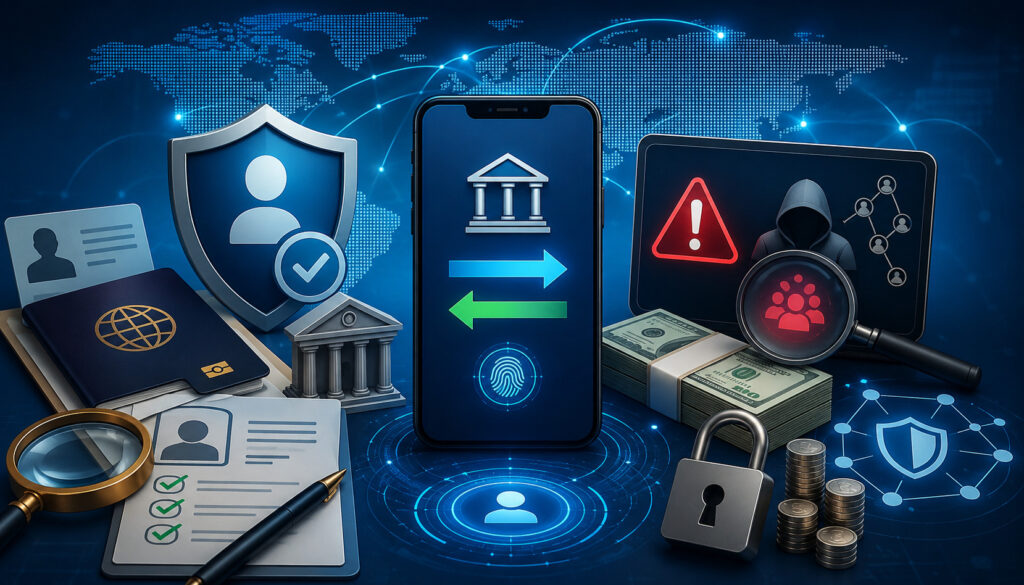
AML and customer due diligence controls help organizations understand who is using payment services and whether activity is consistent with expected behavior. The official customer due diligence rule information explains how customer due diligence supports financial transparency and helps prevent misuse of legal entities.
AML and KYC controls are central to instant payments compliance. AML focuses on detecting and preventing misuse of financial systems for illicit activity. KYC focuses on understanding who the customer is. Together, they help organizations decide whether a customer, account, transaction, or payment pattern presents unacceptable risk.
Instant payments create AML and KYC challenges because activity can happen quickly, repeatedly, and across different systems. A customer may send many smaller payments, use new recipients, change behavior suddenly, or move funds through multiple accounts. Transaction monitoring must be fast enough to detect suspicious patterns before risk escalates.
Customer due diligence and beneficial ownership expectations are important parts of financial transparency. Official guidance explains that customer due diligence requirements are designed to strengthen transparency and prevent misuse of legal entities to disguise illicit activity.
AML controls should not stop at onboarding. Organizations should monitor activity over time, update customer risk profiles, review unusual behavior, escalate suspicious activity, and keep appropriate records.
Customer Identification
Customer identification helps confirm who is sending or receiving funds. For individuals, this may include verifying identity information, contact details, account ownership, and risk indicators. For businesses, it may include legal name, registration details, address, ownership structure, authorized representatives, and expected transaction activity.
In instant payment environments, weak identification can lead to serious risk. A fraudster may create an account, receive funds, move money quickly, and disappear before manual review occurs. Strong identification reduces the chance that payment services are used by fake users, stolen identities, or disguised entities.
Customer identification should also connect to permissions. A verified customer account does not mean every user should have unlimited payment authority. Organizations should confirm who can initiate payments, approve payments, change recipient details, and access sensitive information.
Beneficial Ownership Review
Beneficial ownership review helps identify the individuals who own or control a legal entity. This matters because some business structures can hide the real people behind an account. In payment compliance, understanding ownership can help detect shell entities, nominee arrangements, high-risk relationships, or activity inconsistent with the stated business purpose.
Beneficial ownership review is especially important for business instant payments, marketplace sellers, cross-border flows, high-risk industries, and entities with complex ownership structures. It can also support sanctions screening and enhanced due diligence because a business may not appear restricted by name, but an owner or controller may require closer review.
Official beneficial ownership requirements for certain covered financial institutions include written procedures reasonably designed to identify and verify beneficial owners of legal entity customers.
Organizations should keep ownership records updated when triggering events occur, such as ownership changes, new control persons, unusual activity, or changes in business model.
Ongoing Monitoring
Compliance does not stop after onboarding. A customer that appears low risk at the beginning may later show unusual behavior. For example, payment volume may rise sharply, recipients may change, transactions may be split into smaller amounts, or activity may shift to unexpected corridors.
Ongoing monitoring helps identify these changes. It can include transaction monitoring, periodic risk reviews, sanctions rescreening, device monitoring, payee analysis, and review of customer support signals. The goal is not to block ordinary growth. The goal is to identify behavior that no longer matches the customer’s expected profile.
Monitoring should also include escalation procedures. When an alert appears, someone should know who reviews it, what information is needed, how quickly it must be handled, and how the decision is documented.
KYB Challenges for Business Instant Payments

KYB means knowing and verifying a business customer. It helps payment providers and financial institutions determine whether a business is real, active, properly represented, and consistent with its stated payment activity.
KYB can include business registration records, ownership details, website review, industry classification, source of funds, payment purpose, expected volume, and risk category.
Business instant payments create KYB challenges because companies may send or receive larger amounts, pay many vendors, manage payroll, support marketplaces, process refunds, or move funds internationally.
A weak KYB process can allow fake businesses, mule networks, unauthorized operators, or misleading entities to access fast payment rails.
KYB also matters for B2B payment users. A business may need to verify vendors, contractors, sellers, or payout recipients before sending funds. This is especially important when a new vendor asks for urgent payment, an existing vendor changes bank details, or a marketplace seller requests frequent payouts.
Strong KYB is risk-based. A low-volume local service provider may require a different review than a high-volume cross-border marketplace. The review should match the risk.
Verifying Business Legitimacy
Verifying business legitimacy means checking whether a business is real, active, and consistent across documents and public-facing records. This may include reviewing registration information, business addresses, ownership records, online presence, invoices, contracts, product or service descriptions, and expected transaction patterns.
Instant payments make legitimacy checks more important because funds can move before a business relationship is fully understood. A fake company may appear legitimate enough to pass a basic form but fail deeper review when documents, website content, ownership records, and payment activity are compared.
For vendors, businesses should confirm that payment instructions match trusted records. A legitimate vendor can still be impersonated by a fraudster. That is why verification should include both KYB review and payment detail controls.
Understanding Business Purpose
Understanding business purpose means knowing why the business uses instant payments and whether the activity makes sense. A payroll provider, marketplace, contractor platform, supplier, retailer, and treasury team may all use instant payments differently. Their transaction volumes, payment timing, recipient types, and refund patterns may also differ.
A mismatch between stated business purpose and actual activity can be a warning sign. For example, a business that claims to sell low-value services but suddenly sends high-value payments to unrelated recipients may require review. A vendor that frequently changes bank details may also require additional verification.
Business purpose review supports instant payment risk management because it creates expectations. Once expectations are documented, monitoring systems can compare real activity against those expectations.
Sanctions Screening in Real-Time Payment Systems
Sanctions screening is a major global payment compliance challenge. Organizations may need to screen customers, payees, beneficial owners, counterparties, transaction details, destination information, and payment purpose data against applicable sanctions lists.
Official sanctions resources describe programs that may be comprehensive or selective and may involve blocking assets or trade restrictions.
In instant payment systems, screening must be fast, accurate, and well documented. A payment experience that promises real-time movement cannot rely entirely on slow manual review. At the same time, a rushed process cannot ignore possible matches.
Sanctions screening may produce false positives when names are similar, data is incomplete, spellings vary, or transliteration creates multiple versions of the same name. The challenge is to prevent restricted activity while avoiding unnecessary delays for legitimate payments.
For cross-border instant payment compliance, screening may require more data than domestic payments. Recipient name, location, institution, purpose, and intermediary information may all matter.
Why Sanctions Screening Is Harder at Instant Speed
Sanctions screening is harder at instant speed because the decision window is shorter. A system may need to screen the sender, recipient, account, country, purpose, and message details before the payment is accepted or released. If a potential match appears, the payment may need to pause for review.
This creates a tension between speed and safety. Customers expect quick confirmation, but compliance teams need enough time and data to investigate potential matches. If systems are too loose, restricted activity may pass. If systems are too sensitive, ordinary payments may be delayed by false positives.
The practical answer is better data quality, smarter screening logic, clear escalation rules, and documented decisions. Screening should happen at onboarding, when payees are added, when details change, and when payments are initiated.
False Positives and Manual Review
False positives happen when a screening system flags a potential match that turns out not to be restricted. This may occur because of common names, partial data, misspellings, abbreviations, or incomplete addresses. In real-time payments, false positives can create delays, customer frustration, and operational workload.
Manual review should be structured. Reviewers should know what information to compare, what evidence to collect, when to escalate, and how to document the final decision. A false-positive decision should not be a casual note. It should explain why the alert was cleared based on available information.
Organizations can reduce false positives by improving data quality. Structured names, addresses, dates of birth where appropriate, business identifiers, account details, and payment purpose fields can help screening systems make better decisions.
Cross-Border Screening Risks
Cross-border screening risks are higher because international payments may involve more parties and more data points. A payment may include sender, recipient, sender institution, receiving institution, intermediary entities, country information, currency, purpose, and reference details.
Different corridors may present different risks. Some destinations may require enhanced due diligence, additional documentation, or more careful review. Payment purpose may also matter because certain goods, services, industries, or counterparties can create compliance exposure.
Organizations should maintain clear procedures for cross-border screening. These procedures should explain when a payment can proceed automatically, when it should be held, when enhanced due diligence is required, and who can release a payment after review.
Fraud Prevention and Instant Payment Compliance
Fraud prevention overlaps heavily with instant payments compliance. Fraud can lead to unauthorized transfers, customer harm, suspicious activity, regulatory complaints, operational losses, and reputational damage. In instant payment environments, fraud controls must work quickly enough to stop risky activity before settlement.
Common fraud risks include account takeover, business email compromise, fake invoices, mule accounts, payment redirection, social engineering, authorized push payment scams, and repeated attempts to bypass authentication. These risks are not only technical. Many attacks target people, processes, and trust.
Payment fraud compliance should combine technology and human controls. Technology can detect unusual devices, payment velocity, risky recipients, and failed logins. Human controls can verify vendor changes, challenge urgent requests, review suspicious invoices, and stop payments that do not make business sense.
For additional related guidance, the internal resource on instant payment security best practices explains how authentication, recipient verification, transaction monitoring, and staff training support safer real-time payments.
Account Takeover Fraud
Account takeover fraud happens when criminals gain access to a legitimate user account. They may use stolen passwords, phishing, malware, SIM-swap attacks, compromised email accounts, or reused credentials. Once inside, they may add recipients, change bank details, raise limits, or initiate instant payments.
Instant payments increase account takeover impact because criminals can act quickly. A compromised account can be used to send funds before the account owner notices. If the system does not require step-up authentication for sensitive actions, the attacker may face little resistance.
Controls should include multi-factor authentication, device checks, login alerts, session monitoring, role-based permissions, and step-up approval for new payees or high-value payments. Organizations should also monitor failed login attempts, password resets, new devices, and suspicious changes before payment initiation.
Business Email Compromise
Business email compromise is a serious risk for vendor payments, payroll updates, executive requests, and supplier invoices. A fraudster may impersonate an executive, vendor, employee, or contractor and request payment to a new account. The message may look convincing because it references real invoices, names, or business relationships.
Instant payments make this risk more urgent because funds may move before the business discovers the deception. A rushed email saying “pay today” or “use this new account” should never override verification policy.
Businesses should verify changed bank details through a trusted channel already on file, not through the same email or message that requested the change. Approval workflows should require extra review for new vendors, changed account details, unusual amounts, and urgent requests.
Mule Accounts
Mule accounts are accounts used to receive and move funds from fraud, scams, or other illicit activity. Criminals may recruit people to open accounts, use existing accounts, or allow temporary access. Once funds arrive, they may be moved quickly to other accounts, converted, withdrawn, or transferred across borders.
Mule activity creates monitoring challenges because the receiving account may appear normal at first. Warning signs can include sudden incoming payments from unrelated parties, quick outgoing transfers, activity inconsistent with the customer profile, multiple small transactions, or rapid movement across accounts.
Organizations should monitor both sending and receiving behavior. A strong program looks for payment velocity, unusual counterparties, rapid fund movement, and relationships between accounts.
Real-Time Fraud Control Table
| Fraud risk | Warning signs | Instant payment concern | Control to consider | Record to keep |
| Account takeover | New device, password reset, unusual login | Fraudster may send funds quickly | MFA, device trust, step-up approval | Login logs, device records, alert decisions |
| Fake invoices | New account details, mismatched invoice data | Payment may go to fraudster | Invoice matching and callback verification | Invoice, purchase order, verification notes |
| Changed bank details | Vendor asks for urgent update | Legitimate vendor may be impersonated | Trusted-channel confirmation | Change request, approval, verification record |
| Mule activity | Rapid incoming and outgoing funds | Funds may disappear quickly | Velocity rules and counterparty monitoring | Alerts, account review notes |
| Unusual payment velocity | Many payments in short period | Possible structuring or takeover | Transaction limits and risk scoring | Velocity reports, review decisions |
| New payees | First-time recipient with high value | No history to validate trust | Payee verification and approval | Payee setup records |
| High-value payments | Amount exceeds normal pattern | Larger loss if fraudulent | Dual approval and enhanced review | Approval trail, supporting documents |
| Failed authentication | Repeated failed login or MFA attempts | Possible credential attack | Lockouts and security alerts | Authentication logs |
Consumer Protection Challenges
Consumer protection can be complicated in instant payments because customers may expect fast service, simple refunds, and immediate answers. At the same time, unauthorized transfers, mistakes, scams, and disputes require careful investigation and documentation.
Official electronic fund transfer rules include consumer protections related to unauthorized transfers and error resolution for covered electronic fund transfers. Organizations should not treat customer claims casually simply because a payment was fast or final.
Consumer-facing instant payments should include clear confirmations before submission. Users should understand the recipient, amount, timing, finality, and refund limitations before they approve. Payment status tracking should also be available so users know whether a payment is pending, completed, failed, rejected, or under review.
Customer support teams need training. They should understand the difference between an unauthorized transfer, a mistaken payment, a scam claim, a delayed payment, and a refund request.
Unauthorized Payment Claims
Unauthorized payment claims may require investigation, communication, and records. The organization may need to determine whether the customer authorized the transfer, whether credentials were compromised, whether account access controls worked, and whether the reported activity matches system logs.
In instant payment environments, speed can make these investigations more difficult because funds may already be available to the recipient. That does not remove the need for a documented process. Teams should preserve login records, authentication events, payment confirmations, device details, customer communications, and investigation notes.
A consistent claims process helps protect both customers and the organization. It reduces confusion, supports fair treatment, and creates an audit trail if the decision is later reviewed.
Scam and Authorized Payment Issues
Scam claims can be difficult because the customer may have authorized the payment but was deceived. Examples include romance scams, fake investments, fake vendor requests, impersonation, urgent family scams, and fraudulent purchase requests.
The compliance challenge is that the payment instruction may appear authorized, while the underlying reason for the payment was fraudulent. Instant payments can make this worse because scammers often pressure victims to act quickly.
Organizations should consider warnings, confirmation screens, payee verification, unusual activity alerts, and scam education. These controls can help users pause before sending funds to a new or risky recipient.
Clear Disclosures and Confirmations
Clear disclosures and confirmations help users understand what they are doing before they submit a payment. A confirmation screen should show the recipient, amount, account reference where appropriate, payment timing, and any important limitations.
Disclosures should be practical and visible at the right moment. A long policy hidden in an account agreement may not help a user who is about to send funds to a new recipient. The goal is to reduce avoidable mistakes and support informed payment authorization.
Settlement Finality and Dispute Challenges
Settlement finality is central to instant payment compliance. Once an instant payment is completed, reversing the original payment may not be simple. Mistaken payments, duplicate payments, misdirected funds, scam payments, and disputed transfers may require separate procedures.
This is different from payment methods that support standardized chargeback processes or delayed settlement windows. In many instant payment flows, the sending organization must focus on verification before release and exception handling after completion.
Dispute challenges also involve customer expectations. A customer may assume that any mistaken payment can be pulled back immediately. A business may assume that a refund is the same as reversing the original payment. These assumptions can create confusion.
Organizations should define how they handle payment recalls, refunds, returns, failed payments, compliance holds, and exceptions. The internal resource on payment settlement times can help readers understand why settlement timing affects payment operations.
Final Payments Require Strong Verification
Final payments require strong verification because the organization may have limited recovery options after completion. Before release, the payment workflow should confirm the recipient, amount, payment purpose, approval authority, and supporting documentation.
For business payments, this may include matching the payment to an invoice, contract, purchase order, vendor record, and approval policy.
For payroll, it may include verifying employee identity, account changes, pay period details, and authorization. For customer refunds, it may include matching the refund to the original transaction and reviewing fraud signals.
Verification does not need to block every payment. It should be risk-based. Known recipients and routine amounts may move smoothly, while new recipients, changed details, high-value transfers, and urgent requests require stronger review.
Refunds Are Not Always Reversals
A refund is not always the same as reversing the original payment. In some cases, the original instant payment may remain completed, and the refund may be a separate payment sent back to the sender. This distinction matters for accounting, audit trails, customer support, and compliance records.
A separate refund should be documented with a reference to the original payment. Teams should record why the refund was issued, who approved it, when it was sent, and how it was reconciled. If fees, currency conversion, or partial refunds are involved, those details should be clear.
This distinction also matters for fraud. Fraudsters may exploit refund workflows by requesting refunds to different accounts or claiming mistaken payments. Refund controls should verify the recipient and reason before release.
Exception Handling
Exception handling covers failed payments, rejected payments, misdirected funds, duplicate payments, compliance holds, delayed confirmations, and disputed transfers. Instant payment systems need clear procedures because exceptions can create customer confusion quickly.
A good exception process defines ownership. Operations may handle failed statuses, compliance may review sanctions holds, fraud teams may investigate suspicious activity, finance may reconcile adjustments, and customer support may communicate with users.
Exception queues should be monitored regularly. A payment stuck in an unclear status can create duplicate payment risk if a system retries incorrectly or a user manually resubmits.
Cross-Border Instant Payment Compliance
Cross-border instant payment compliance is more complex than domestic payment compliance because it can involve multiple regulatory systems, currencies, institutions, data flows, and risk checks.
A single payment may require AML screening, sanctions review, currency conversion records, recipient validation, privacy controls, purpose details, and settlement transparency.
Cross-border payments are also important for marketplaces, exporters, importers, freelancers, international contractors, payroll teams, treasury teams, and B2B users. These groups often care about speed, cost, transparency, and certainty. Compliance controls must support those goals while managing risk.
International payment compliance may require more detailed records than domestic flows. Organizations should retain sender and recipient details, payment purpose, currency conversion information, fees, timestamps, status confirmations, screening results, and any exception notes.
Global efforts to improve cross-border payments focus on better speed, access, cost, and transparency, but safe implementation still requires risk controls.
Multiple Jurisdictions
A cross-border payment may involve rules from the sender’s location, recipient’s location, payment rail, banks, intermediaries, and service providers. This creates complexity because one payment can trigger several compliance responsibilities.
For example, sender verification may be handled in one system, recipient screening in another, currency conversion in another, and regulatory reporting in another. If these systems do not share data properly, gaps may appear.
Organizations should map the full payment chain. The map should show where the payment starts, where it travels, which parties touch it, where data is stored, and which rules or controls apply at each step.
Currency and FX Compliance
Currency and FX compliance involves exchange rates, fees, conversion timing, final amount received, and records. When payments move quickly, users still need transparency. A sender should understand what currency is being sent, what currency is received, and what costs may apply.
Finance teams should also track FX differences for reconciliation. A payment approved in one currency may settle or be recorded in another. Without clear records, accounting teams may struggle to match invoices, settlement reports, bank entries, and customer confirmations.
Currency conversion records should include the original amount, converted amount, rate source where available, fees, timestamps, and payment reference. These records support reconciliation, customer support, and audit review.
Payment Purpose and Recipient Data
Cross-border payments often require clearer recipient information and payment purpose details. This may include the recipient’s full name, address where appropriate, account details, institution details, invoice reference, purpose code, or business reason.
Better data helps compliance screening and reduces ambiguity. A vague reference such as “payment” is less useful than an invoice number, contract reference, payroll period, refund ID, or vendor account reference.
Software teams should design payment forms and APIs to capture structured recipient and purpose data. This improves screening, reconciliation, reporting, and customer support.
Data Privacy and Cross-Border Payment Data
Instant payments require careful handling of payment data. Names, account details, addresses, identity records, transaction references, device data, authentication events, and payment history may all be sensitive. When payments move across systems, privacy and security controls become essential.
Data privacy in instant payments includes data minimization, secure storage, access permissions, privacy notices, retention practices, vendor oversight, and cross-border data transfer review. Organizations should collect what they need, protect what they store, and limit who can access sensitive data.
Payment data may be shared among internal systems, banks, processors, compliance screening tools, fraud platforms, customer support systems, accounting software, and regulatory reporting workflows. Each connection should be reviewed for purpose, security, access, and retention.
Sensitive Payment Information
Sensitive payment information can include names, account numbers, routing details, payment references, addresses, identity documents, business ownership records, authentication logs, and transaction histories. If exposed, this information can support fraud, identity theft, account takeover, or social engineering.
Organizations should protect sensitive payment data with encryption, tokenization where appropriate, access controls, logging, and secure retention practices. Staff should only access the information needed for their role.
Sensitive information should also be protected in customer support workflows. Payment teams should avoid sending account details through unsecured channels or exposing unnecessary data in tickets, chats, or emails.
Data Sharing Across Systems
Instant payment systems often rely on APIs, banking partners, processors, screening tools, fraud tools, accounting systems, and reporting platforms. These systems may exchange payment instructions, status updates, customer data, and risk signals.
Data sharing creates operational value, but it also creates risk. A weak integration can expose credentials, duplicate payment instructions, leak sensitive records, or create inconsistent payment status information.
Organizations should review API permissions, data fields, encryption, logging, vendor access, and retention rules. They should also test how systems behave when a notification is delayed, duplicated, missed, or received out of order.
Record Retention and Access Control
Record retention means keeping necessary payment records for compliance, audit, dispute, and reconciliation purposes. Access control means limiting who can view, edit, export, or delete those records.
Organizations should retain payment instructions, approvals, confirmations, screening results, fraud alerts, dispute records, refunds, reconciliation notes, and status changes according to applicable requirements and internal policy. At the same time, they should avoid retaining unnecessary sensitive data longer than needed.
Access should be role-based. A customer support agent may need payment status visibility, but not full identity documents. A finance manager may need reconciliation reports, but not system credentials.
Cybersecurity Challenges in Global Instant Payments
Cybersecurity is essential for instant payment compliance because payment systems are high-value targets. Attackers may try to steal credentials, compromise APIs, manipulate payment instructions, intercept data, alter bank details, or disrupt service availability.
Cybersecurity controls should include strong authentication, multi-factor authentication, encryption, tokenization, secure APIs, key management, device security, user permissions, monitoring, logging, incident response, and vendor risk management.
The official cybersecurity framework provides a widely used structure for managing cybersecurity risk across organizations of different sizes and sectors.
Instant payment cybersecurity is not only an IT issue. It affects compliance, fraud prevention, customer trust, operational resilience, and financial controls. If an attacker compromises a payment approval account, the result may be both a security incident and a payment loss.
Strong Authentication
Strong authentication helps confirm that a user is allowed to access an account and approve payment actions. Basic passwords are not enough for systems that can move money. Multi-factor authentication, device trust, passkeys where supported, biometrics, session controls, and step-up approval can reduce account takeover risk.
Authentication should protect both login and sensitive actions. A user may successfully log in, but adding a new payee, changing bank details, increasing payment limits, or sending a high-value payment should trigger additional verification.
Organizations should also remove access promptly when employees change roles or leave. Dormant accounts and excessive permissions create avoidable risk.
API Security
Instant payment APIs need strong security because they may initiate payments, retrieve status updates, store credentials, and connect multiple systems. API weaknesses can lead to unauthorized transactions, data exposure, duplicate payments, or service disruption.
Controls should include secure credentials, scoped permissions, encryption, rate limits, input validation, idempotency keys, logging, monitoring, and key rotation. Secrets should not be hardcoded into applications or stored in unsafe files.
API integrations should also be tested in sandbox environments before going live. Testing should include failed payments, duplicate requests, timeout handling, webhook retries, status mismatches, and compliance holds.
Incident Response
Incident response is the plan for handling fraud events, data breaches, outages, account compromise, suspicious activity, and payment errors. In instant payments, response time matters because funds and data can move quickly.
An incident plan should define who investigates, who communicates with customers, who contacts financial partners, who preserves logs, who pauses payment activity, and who approves recovery steps. The plan should also include escalation paths for legal, compliance, security, finance, and leadership teams.
After an incident, organizations should review what happened and improve controls. Lessons may include stronger authentication, better monitoring, improved staff training, tighter payee verification, or clearer customer communication.
Operational Resilience and Uptime Challenges
Instant payment systems must be reliable because users may depend on them for time-sensitive payments. Payroll, emergency disbursements, supplier payments, marketplace payouts, and customer refunds can create high expectations for uptime and status certainty.
Operational resilience includes availability, latency, backup processes, failover, monitoring, customer support, reconciliation, exception queues, and business continuity planning. If a system outage occurs, organizations need clear fallback workflows and communication plans.
Instant payment operations also require strong status management. A delayed confirmation can create confusion. A user may retry a payment, customer support may give incorrect information, or finance may struggle to reconcile the payment.
System Availability
System availability is critical because instant payments may operate outside traditional business hours. Businesses and financial institutions need monitoring and support processes that match the payment service promise.
Availability planning should include infrastructure redundancy, vendor monitoring, failover procedures, and incident communication. Teams should know what happens if the payment gateway, banking connection, API, fraud tool, or reconciliation system is unavailable.
A resilient system should fail safely. If screening or authorization controls are unavailable, the system should not automatically release risky payments without review.
Delayed Status Updates
Delayed status updates can create operational and customer support problems. A payment may be initiated, pending, accepted, rejected, failed, held, or completed. If systems do not communicate the correct status, users may retry payments or assume funds were lost.
Payment status mapping should be precise. Software teams should define what each status means, what action is allowed, and when customer support should intervene.
Status logs should include timestamps, system messages, reference IDs, and error codes. These records support troubleshooting, reconciliation, and dispute resolution.
Business Continuity Planning
Business continuity planning helps organizations continue critical payment operations during outages, cyber incidents, provider disruptions, staffing issues, or system failures. The plan should identify essential payment types, fallback processes, approval rules, and communication steps.
Fallback workflows should be controlled. A manual workaround should not bypass verification, approval, or recordkeeping. In fact, manual processes often require stronger documentation because they may not automatically create system logs.
Compliance Challenges With APIs and Payment Integrations
API-based payment systems introduce compliance and operational challenges because payment activity may be initiated, updated, confirmed, retried, and reconciled across multiple systems. A small integration mistake can create duplicate payments, missing audit trails, incorrect statuses, or weak authorization.
Instant payment API integration should include authentication, authorization, webhook reliability, duplicate payment prevention, error handling, payment status mapping, audit logs, sandbox testing, and integration documentation. Secure instant payment APIs are often discussed as a core part of modern faster payment implementation.
APIs should also support compliance data capture. Payment purpose, recipient data, approval ID, invoice reference, screening result, and status history should be available for review.
Duplicate Payment Prevention
Duplicate payment prevention is essential in real-time payment APIs. A timeout, retry, user refresh, webhook delay, or system error can cause the same payment instruction to be submitted more than once if the integration is not designed carefully.
Idempotency keys, unique payment references, retry rules, and status checks can reduce duplicate payment risk. A system should know whether a payment request is new or a retry of an existing instruction.
Finance and customer support teams should also know how duplicate payments are identified and corrected. The records should show which payment was original, which was duplicate, and how the issue was resolved.
Webhook and Status Monitoring
Webhooks can notify systems when payment status changes. They are useful, but they can be delayed, repeated, missed, or received out of order. If the receiving system assumes every webhook is perfect, errors can occur.
A strong integration should verify webhook authenticity, handle duplicates, reconcile status with the source system, and maintain a payment status history. It should also have a process for identifying missing updates.
Status monitoring is especially important when payments can be held for compliance review. A payment should not be treated as completed until the authoritative status confirms completion.
Audit Trails
Audit trails document payment approvals, API calls, status updates, user actions, screening results, and exceptions. They help organizations investigate disputes, fraud claims, compliance questions, duplicate payments, and system errors.
A useful audit trail should show who did what, when it happened, which system recorded it, and what changed. It should also preserve the reason for manual decisions, such as clearing a sanctions false positive or approving a high-risk payment.
Audit logs should be protected from unauthorized modification. If logs can be edited freely, they lose value as compliance evidence.
Recordkeeping and Audit Trail Requirements
Accurate records are central to payment compliance. Instant payments may move quickly, but organizations still need evidence of payment instructions, sender details, recipient details, approvals, confirmations, timestamps, FX information, screening results, fraud alerts, refunds, disputes, and reconciliation notes.
Recordkeeping supports compliance reviews, customer support, internal audits, dispute resolution, regulatory reporting, fraud investigations, and accounting accuracy. Weak records make it difficult to prove what happened.
Records should be searchable and organized. A finance team should be able to connect a payment to an invoice, approval, settlement record, bank entry, and accounting entry. A compliance team should be able to connect a payment to screening results and risk decisions.
Payment Approval Records
Payment approval records show who approved a payment, when it was approved, and under what policy. These records matter because instant payments may not provide much time for later correction.
Approval records should include user identity, role, timestamp, amount, recipient, payment purpose, supporting documents, and any required second approval. For high-risk payments, the record should also show what extra review occurred.
Businesses should avoid shared logins because they weaken approval records. Every payment user should have a unique account so actions can be traced accurately.
Screening Records
Screening records show whether sanctions, AML, fraud, or risk checks were performed. These records may include screening date, data used, match result, false-positive review, escalation notes, and final decision.
Screening records are especially important for cross-border instant payment compliance. If a payment is later questioned, the organization should be able to show what checks were performed before release.
Records should also capture updates. If a customer or payee is rescreened after a change, the new result should be stored with the relevant timestamp.
Reconciliation Records
Reconciliation records help finance teams match payments to invoices, settlement reports, bank records, refunds, fees, FX adjustments, and accounting entries. Without good reconciliation, instant payments can create accounting confusion.
Records should include payment reference, settlement ID, invoice number, customer or vendor ID, amount, currency, fees, timestamps, and final status. For refunds or corrections, records should link the new payment to the original payment.
The internal resource on instant payments versus traditional ACH transfers can help readers compare why faster payment timing changes reconciliation workflows.
Instant Payment Reconciliation Challenges
Reconciliation is harder when payments move instantly across accounts, systems, currencies, and regions. A payment may be initiated in one system, confirmed by another, settled through a rail, recorded in a bank statement, and matched in accounting software. If references are inconsistent, manual work increases.
Instant payment reconciliation challenges include settlement IDs, payment references, fees, refunds, failed payments, currency conversion, batch versus real-time records, duplicate payments, and accounting integration. Real-time payments may produce many individual records rather than convenient batches.
Finance teams should work with software teams before launch. Payment references, invoice IDs, customer IDs, vendor IDs, and status fields should be structured so reconciliation can be automated where possible.
Matching Payments to Invoices
Matching payments to invoices is easier when payment instructions include structured references. Invoice numbers, customer IDs, vendor IDs, order numbers, refund IDs, and payroll period references all help reduce manual matching.
Unstructured references create problems. A payment labeled only “services” may require manual research. If the payment amount is partial, includes fees, or involves currency conversion, the matching process becomes even harder.
Organizations should define reference standards and require them in payment forms and APIs. Consistency helps finance, support, compliance, and audit teams.
Tracking Fees and Adjustments
Fees, FX differences, refunds, returned payments, and corrections should be tracked separately from the principal payment amount. If fees are blended into payment totals without detail, accounting records can become unclear.
Cross-border payments may involve exchange-rate differences and intermediary costs. Even domestic payments may involve service fees or adjustments depending on the provider and account setup.
Finance teams should store fee records with the payment ID. This helps reconcile bank statements, customer records, vendor payments, and accounting entries.
Integrating Accounting and Treasury Systems
Accounting and treasury integrations can improve reconciliation by reducing manual exports and duplicate data entry. APIs, reporting files, and standardized payment data can connect payment activity to ledgers, cash forecasting, and bank records.
Treasury teams need visibility into available funds, expected outflows, settlement status, and failed payments. Instant payments can improve liquidity control, but only if data is accurate and timely.
Integration testing should include real-world scenarios, such as partial refunds, rejected payments, duplicate prevention, currency conversion, and delayed status updates.
ISO 20022 and Compliance Data Quality
ISO 20022 supports richer and more structured payment messaging. In simple terms, it helps payment systems use consistent data fields for parties, amounts, references, purpose, and other payment details. The official ISO resource describes ISO 20022 as a common platform for financial message development.
Better payment messaging can support compliance because structured data reduces ambiguity. Screening systems can compare names and parties more accurately. Finance teams can reconcile invoices more easily. Customer support teams can understand payment purpose faster. Compliance teams can review audit trails with more context.
The internal article on the role of ISO 20022 in payment infrastructure modernization provides helpful background on why structured payment data matters for modern payment systems.
Structured Payment Data
Structured payment data means information is placed in consistent fields rather than scattered across free-text notes. This can include sender name, recipient name, account details, amount, currency, invoice number, payment purpose, and reference ID.
Structured data improves compliance review because systems can analyze the right information in the right place. It also reduces manual work because staff do not need to interpret unclear payment descriptions.
For software teams, structured data should be part of API design. Forms should guide users to enter complete and accurate information before payment submission.
Better Screening and Reporting
Better data can improve sanctions screening, AML monitoring, fraud detection, reporting, and audit trails. A complete recipient name, structured address, business identifier, and purpose field can reduce false positives and support better risk decisions.
Reporting also becomes easier when data is consistent. Compliance teams can identify patterns, finance teams can reconcile payments, and operations teams can investigate exceptions.
Compliance Challenges by Use Case
Global instant payment compliance challenges vary by use case. Payroll, vendor payments, marketplace payouts, customer refunds, B2B payments, international contractors, treasury operations, and consumer payments all create different risk patterns.
A single compliance policy may not be enough for every workflow. Each use case should be mapped separately, including sender, recipient, payment purpose, approval process, risk level, data fields, records, and exception handling.
The strongest programs use a common control framework but adapt it to each payment scenario. This creates consistency without forcing every payment into the same workflow.
Payroll Payments
Payroll payments require accurate worker identity, timing controls, payment records, approvals, and confirmations. Account changes should be verified carefully because payroll diversion is a common fraud risk.
Payroll teams should document who approved the payment file, who changed worker account details, and when funds were released. Failed payments and corrections should be tracked separately.
Instant payroll can be useful, but speed should not override identity and authorization controls.
Vendor Payments
Vendor payments require vendor verification, invoice validation, bank detail controls, and approval workflows. Fake invoices and changed account instructions are major risks.
Businesses should verify new vendors and confirm changed bank details through trusted channels. High-value or urgent vendor payments should require additional review.
Payment references should connect to invoices, purchase orders, contracts, and approvals.
Marketplace Payouts
Marketplaces may send many payouts to sellers, contractors, or service providers. This creates KYB, KYC, fraud, dispute, reconciliation, and monitoring challenges.
Seller verification should occur before payouts begin. Ongoing monitoring should detect unusual payout behavior, sudden volume spikes, refund abuse, or suspicious account changes.
Marketplace payout records should connect seller identity, transaction history, payout amount, fees, and dispute status.
Customer Refunds
Customer refunds require clear records, fraud review, status tracking, and communication. A refund should be linked to the original transaction, order, invoice, or claim.
Refunds to new accounts may require extra verification. Fraudsters may attempt to redirect refunds by claiming a different account should be used.
Customer support teams should understand refund timing and finality so they can explain status accurately.
B2B Payments
B2B payments may involve larger amounts, invoice references, approval workflows, and compliance records. They may also involve multiple departments, such as procurement, finance, treasury, and operations.
Large payments should be supported by documentation. New recipients, changed account details, unusual timing, and cross-border flows should trigger stronger review.
B2B reconciliation improves when payments include structured invoice and vendor references.
International Contractors
International contractor payments may require identity checks, business verification where relevant, currency details, purpose records, and payment confirmations. Cross-border payment regulations may also require additional data depending on the corridor and payment type.
Organizations should document contractor identity, payment purpose, amount, currency, fees, and status. Account changes should be verified before payment release.
These controls help reduce fraud, errors, and support issues.
Treasury Operations
Treasury teams need liquidity visibility, settlement tracking, approvals, risk monitoring, and reconciliation. Instant payments can improve cash control, but they can also increase liquidity risk if outflows are not monitored.
Treasury workflows should include payment limits, funding checks, settlement reporting, and exception alerts. Cross-border treasury payments may also require FX records and corridor-specific controls.
Treasury teams should coordinate with compliance and finance so payment speed does not reduce oversight.
Consumer Payments
Consumer-facing instant payments require clear communication, account security, dispute support, and fraud monitoring. Users should understand payment timing, recipient details, and finality before confirming.
Consumer workflows should include login security, payee confirmation, transaction alerts, and easy reporting for suspicious activity. Support teams should document claims and investigation steps.
Scam prevention messaging can help users pause before sending funds under pressure.
Instant Payment Compliance Framework Table
| Compliance area | Control objective | Examples of controls | Responsible team | Records to keep |
| KYC | Verify customer identity | Identity checks, risk scoring, account ownership review | Compliance, onboarding | Verification results, risk profile |
| KYB | Verify business legitimacy | Registration review, ownership review, website check | Compliance, risk | Business records, beneficial ownership data |
| AML | Detect suspicious activity | Transaction monitoring, escalation rules | Compliance, fraud | Alerts, investigation notes |
| Sanctions | Avoid restricted activity | Customer, payee, and transaction screening | Compliance | Screening logs, false-positive decisions |
| Fraud | Prevent payment misuse | MFA, velocity rules, payee verification | Fraud, security, operations | Fraud alerts, case notes |
| Cybersecurity | Protect systems and data | Encryption, API security, access controls | Security, technology | Access logs, incident reports |
| Data privacy | Protect payment information | Data minimization, retention limits | Privacy, compliance, technology | Data maps, access records |
| Consumer protection | Support fair treatment | Disclosures, claims handling, error review | Support, compliance | Claims, communications, resolutions |
| Reconciliation | Match payments accurately | References, settlement IDs, accounting integration | Finance, treasury | Bank records, invoice matches |
| Operational resilience | Maintain reliable service | Monitoring, failover, continuity planning | Operations, technology | Outage logs, recovery records |
Common Mistakes With Global Instant Payment Compliance
Common mistakes begin with treating instant payments like reversible payments. If teams assume they can easily fix errors later, they may skip verification before release. That is risky because finality changes the control model.
Another mistake is weak payee verification. New recipients, changed bank details, urgent vendor requests, and unusual refund instructions should not be approved based only on email or chat messages.
Poor API security is also a major issue. Weak credentials, missing rate limits, unsafe secrets, incomplete logs, and poor retry logic can create unauthorized access or duplicate payments.
Other common mistakes include:
- Missing approval workflows for high-risk payments
- Unclear payment records and weak audit trails
- Limited sanctions screening or poor false-positive documentation
- Ignoring cross-border data rules and privacy expectations
- Not training employees on payment fraud compliance
- Skipping reconciliation because payments are “already confirmed”
- Relying only on manual review when payments move instantly
- Failing to monitor fraud patterns after launch
- Giving too many users payment release permissions
- Not testing outage and exception workflows
How Businesses Can Prepare for Instant Payment Compliance
Businesses can prepare by identifying payment use cases, mapping payment flows, reviewing responsibilities, choosing secure tools, verifying recipients, setting approval rules, documenting policies, training staff, monitoring transactions, reconciling payments, and reviewing authoritative sources.
Preparation should start before payment volume grows. A small pilot may seem low risk, but weak controls can become dangerous when more departments, currencies, vendors, customers, and systems are added.
Organizations should also keep compliance flexible. Instant payment regulations, fraud patterns, data standards, and cross-border payment regulations can change. Policies should be reviewed regularly and updated when business activity changes.
Map Payment Flows
Mapping payment flows means understanding who sends payments, who receives them, what systems are involved, where compliance checks occur, and what records are created. This map should include onboarding, payee setup, payment initiation, approval, screening, release, confirmation, reconciliation, dispute handling, and refunds.
Flow mapping helps teams find gaps. For example, a business may discover that vendor changes are approved in email but not logged in the payment system. Or it may find that compliance screening happens at onboarding but not when payee details change.
A good payment map should be practical enough for operations, finance, compliance, and software teams to use.
Define Approval Rules
Approval rules should reflect risk. Routine low-value payments to known recipients may require fewer checks than high-value payments to new recipients. Cross-border payments, changed account details, unusual timing, and urgent requests may require extra review.
Approval rules should define thresholds, required reviewers, documentation, escalation paths, and exceptions. They should also prevent one person from controlling the entire payment workflow when risk is high.
Rules should be built into systems where possible. Manual policies are useful, but automated workflows reduce the chance that employees forget a step.
Train Employees
Employee training is essential because many fraud attempts target people. Staff should understand payment finality, scam tactics, vendor verification, account takeover, invoice fraud, social engineering, and escalation procedures.
Training should be role-specific. Finance staff need vendor and invoice controls. Customer support staff need dispute and refund procedures. Software teams need API and audit trail requirements. Leadership needs approval and risk ownership awareness.
Training should also encourage employees to pause suspicious payments without fear of blame. A culture that rewards speed over verification creates unnecessary risk.
How to Evaluate Instant Payment Compliance Tools and Providers
Organizations should evaluate instant payment tools and providers neutrally, based on capabilities, controls, documentation, and fit for the use case. The goal is not to choose the most feature-heavy option. The goal is to choose a solution that supports secure, compliant, and auditable payment operations.
Evaluation areas include supported payment rails, KYC/KYB capabilities, sanctions screening, AML monitoring, fraud tools, API security, reporting, audit logs, reconciliation support, data privacy controls, customer support, documentation, uptime, and exception handling.
Businesses should also ask how the provider handles payment statuses, failed payments, duplicate prevention, refunds, compliance holds, webhook retries, and cross-border data. These operational details matter after launch.
Review Screening Capabilities
Screening capabilities should cover customers, businesses, beneficial owners where applicable, recipients, and transactions. Organizations should understand when screening occurs, what data is used, how false positives are handled, and what records are available.
For international instant payment compliance, screening should support cross-border corridors, recipient details, destination information, and payment purpose where needed.
A tool should help teams make documented decisions, not simply produce unexplained alerts.
Review Reporting and Audit Logs
Reporting and audit logs are critical for compliance review, customer support, fraud investigations, and reconciliation. A strong tool should provide downloadable records, timestamps, status history, approval details, screening evidence, and user activity logs.
Audit logs should be detailed enough to answer basic questions: Who initiated the payment? Who approved it? What changed? What screening occurred? What status was received? What exception happened?
If records are difficult to export or interpret, compliance and finance teams may struggle during reviews.
Review Security Controls
Security controls should include authentication, encryption, access permissions, API security, monitoring, logging, and incident response. Organizations should understand how credentials are protected, how users are permissioned, and how suspicious activity is detected.
Role-based access is especially important. Users should only have the permissions needed for their job. Admin access should be limited and monitored.
Vendor security should also be reviewed. If a provider stores or processes sensitive payment data, its security controls affect the organization’s risk.
Best Practices for Managing Global Instant Payment Compliance Challenges
Managing global instant payment compliance challenges responsibly requires layered controls. No single tool, checklist, or policy can manage every risk. Organizations should combine technology, documented procedures, trained teams, and regular review.
Useful best practices include:
- Verify customers, businesses, and payees before payment activity begins
- Use risk-based controls for payment amount, recipient type, corridor, and behavior
- Screen customers, recipients, and transactions for sanctions and compliance risk
- Monitor transactions for unusual velocity, new payees, and account changes
- Secure APIs with strong authentication, scoped permissions, and logging
- Apply approval workflows for high-value, new-recipient, or cross-border payments
- Train staff on fraud tactics and escalation procedures
- Keep accurate records of payment decisions, approvals, and screening results
- Reconcile payments regularly using structured references and settlement IDs
- Review fraud patterns, failed payments, disputes, and exceptions
- Stay informed through authoritative regulatory, cybersecurity, and payment resources
FAQs
What are global instant payment compliance challenges?
Global instant payment compliance challenges are the risks and responsibilities that arise when organizations send, receive, screen, monitor, and record fast payments across systems, payment rails, and borders.
These challenges include AML, KYC, KYB, sanctions screening, fraud prevention, cybersecurity, data privacy, consumer protection, settlement finality, reconciliation, and regulatory reporting.
The challenge is that instant payments move quickly. Compliance teams, fraud teams, finance teams, and software systems must often make decisions before funds are released. That requires strong controls, reliable data, and clear records.
Why is instant payment compliance difficult?
Instant payment compliance is difficult because speed reduces review time. A payment that settles quickly may leave little room for manual investigation, correction, or cancellation. That means organizations must verify details before release.
It is also difficult because instant payments involve multiple risk areas at once. A single payment may require authorization, sanctions screening, fraud scoring, data protection, status tracking, and reconciliation. Cross-border payments add even more complexity.
What is global instant payment compliance?
Global instant payment compliance is the process of managing payment rules, controls, monitoring, documentation, and risk reviews for instant payments that may operate across different regions, currencies, systems, and regulatory environments.
It includes customer verification, business verification, AML monitoring, sanctions screening, cybersecurity, payment fraud compliance, data privacy, consumer support, dispute handling, audit trails, and reconciliation. It is a layered compliance approach, not a single checklist.
How do instant payment regulations affect businesses?
Instant payment regulations can affect how businesses authorize payments, verify users, disclose payment terms, handle disputes, monitor fraud, store records, and manage cross-border transactions. Businesses may also be affected by payment rail rules, bank requirements, account agreements, and provider procedures.
The practical impact is that businesses should not treat instant payments as only a faster transfer method. They should review controls, approval workflows, payee verification, staff training, and reconciliation before using instant payments widely.
What are real-time payment compliance challenges?
Real-time payment compliance challenges include limited review time, payment finality, fraud risk, account takeover, sanctions screening, transaction monitoring, customer verification, API security, data privacy, and exception handling.
Because real-time payments may complete quickly, organizations need controls that work before or during payment initiation. Post-payment review is useful, but it cannot replace pre-payment verification for high-risk transactions.
How does AML affect instant payments?
AML affects instant payments by requiring organizations to understand customers, monitor transactions, identify suspicious activity, and keep appropriate records. Instant payment systems may need fast transaction monitoring because suspicious activity can occur quickly.
AML controls may include customer due diligence, beneficial ownership review, risk scoring, transaction monitoring, suspicious activity escalation, and ongoing review. These controls should match the organization’s role and risk profile.
Why is sanctions screening harder with instant payments?
Sanctions screening is harder with instant payments because there is less time to investigate possible matches before funds move. Screening systems may flag similar names, incomplete records, or cross-border details that require manual review.
Organizations need reliable screening data, false-positive procedures, escalation queues, and documented decisions. Cross-border payments may require additional screening of recipients, destinations, purpose details, and intermediary information.
Are instant payments reversible?
Instant payments are often designed with strong finality, which means a completed payment may be difficult to reverse through normal payment operations. In some cases, correction may require a separate refund, recall request, recipient cooperation, or other exception process.
Because reversibility may be limited, organizations should verify recipient details, payment amount, authorization, and business purpose before release. Refund and exception procedures should be documented.
How do cross-border instant payments create compliance risks?
Cross-border instant payments create compliance risks because multiple jurisdictions, currencies, institutions, and data flows may be involved. A payment may require identity checks, sanctions screening, AML monitoring, currency conversion records, purpose details, privacy review, and settlement tracking.
The organization should understand the full payment path. It should know who handles screening, where data is stored, how status is confirmed, what fees or FX details apply, and what records must be retained.
What records should businesses keep for instant payments?
Businesses should keep payment instructions, sender and recipient details, approvals, timestamps, confirmations, payment references, invoice links, settlement IDs, screening results, fraud alerts, refunds, disputes, failed payment records, FX details, and reconciliation notes.
Records should be accurate, searchable, and protected from unauthorized access. Good records support compliance review, accounting, customer support, dispute resolution, and fraud investigation.
How can businesses manage instant payment compliance responsibly?
Businesses can manage instant payment compliance responsibly by mapping payment flows, verifying customers and payees, using approval workflows, monitoring transactions, screening for sanctions risk, securing APIs, training employees, documenting decisions, reconciling payments, and reviewing controls regularly.
They should also avoid giving payment speed priority over basic verification. Fast payments are most useful when they are supported by strong controls, accurate records, and clear accountability.
Conclusion
Global instant payment compliance challenges come from speed, finality, cross-border complexity, AML requirements, KYC and KYB reviews, sanctions screening, fraud risk, cybersecurity, data privacy, consumer protection, operational resilience, and reconciliation.
Instant payments can help businesses move money more efficiently, but faster movement requires stronger preparation.
Organizations should focus on prevention before payment release. That means verifying customers and payees, screening transactions, securing accounts and APIs, using approval workflows, monitoring unusual behavior, and documenting decisions.
For cross-border payments, they should also pay attention to currency conversion records, recipient data, payment purpose, sanctions exposure, and data sharing.
Responsible instant payment compliance is not about slowing every payment. It is about applying the right control to the right risk at the right moment. Businesses that combine clear policies, secure systems, trained teams, accurate records, and regular review are better prepared to use instant payments safely and confidently.